In the course of this closer inspection of LiDAR imagery, the presence of features appearing like and here referred to as “Scarps” were identified. Interestingly, once conceptually recognized many of these features became fairly obvious, but had been previously overlooked. Many such Scarps were identified, as shown below on the regional map presented in last section of this addendum report.
Scarps have the following characteristics:
- Scarps are distinctive, straight to curved, linear geomorphic forms, appearing on LiDAR imagery as three dimensional, edge-like features on the landscape.
- Scarps truncate the frontal slopes of Ribbed Lacustrine deposits associated with the late T7 margin. Similar deposits above the late T7 level and time, but still within the T7 margin do not appear to be associated with Scarps.
- Scarp bases are sharp, curvilinear horizontal traces, with no apparent lateral topographic gradient. These bases occur close to but slightly above the elevation of the Champlain Sea marine limit, at diverse, scattered locations above this limit when Scarp base elevations are adjusted for isostatic rebound.
- The terrain everywhere in the vicinities of such Scarps and their associated Ribbed Lacustrine deposits is mantled by silt-clay surficial soil deposits indicative of standing water, with no evidence of coarse textured granular soils at Scarps and their bases.
- Scarps and their associated Ribbed Lacustrine deposits together tend to be suggestive of ice lobes along the flanks of the main Champlain Basin and as well in certain but not all tributary Basins, closely associated with physiography. More specifically they suggest ice lobes: a) Along the floor of the central, main Champlain Basin “Trough” as this Basin floor was described previously, essentially along the slope between the Middlebury Bench and the Trough, with Scarps extending along the lateral slope of the Trough from the vicinity of Mount Independence, (at the southwestern extent of the Bench), east of the village of Orwell, northward to the La Platte Basin (near the northern margin of the Bench). Thus, Scarps essentially mark multiple locations along the entire length of the Middlebury Bench, again on the western slope of the Bench as the terrain descends to the main Trough Basin floor, and b) In the southern re-entrant Basins in the Middlebury Bench, in and along the margins of these Basins, specifically including Braisted Branch, West and East Branches of Dead Creak, lower Otter Creek, and Lemon Fair basins. In other words, Scarps are more extensive, penetrating individual re-entrant basins in the southern portion of the Basin, but not in the re-entrant basins to the north. The explanation for this difference is given below.
- A cursory examination of LiDAR imagery in the Champlain Basin north of the April 2026 VCGI map area, meaning north of the Middlebury Bench, suggests that Scarps and Ribbed Lacustrine deposits are less common. However, Scarps have been identified in the Lamoille and Missisquoi Basins, again with similar appearances, at the same levels, in conjunction with the late T7 ice margin, just above the Champlain Sea marine limit.
- Many Scarps are quite subtle, and would not ordinarily be detected or recognized except for the recurrent association with Ribbed Lacustrine deposits at the late T7 level, and close to but slightly above the elevation of the Champlain Sea marine limit. Whereas when Ribbed Lacustrine deposits were first identified and recognized as such, they were thought to be few in number, it is now thought that they are quite common. It is likely that further, closer scrutiny will reveal more such deposits than presently identified and mapped on the 2026 VCGI map.
- In a sense, Scarps and Ribbed Lacustrine deposits together represent a “Signature” on VCGI imagery which can be used independently of the Bath Tub model, similar to the T3/T4 Ice Margin Channel signature, as described previously, to mark the late T7 margin and the nearby but lower Champlain Sea limit strandline.
It is significant to note, as already stated, that the more one examines LiDAR, the more one sees. This applies to the discovery of Scarps and Ribbed Lacustrine deposits. Seeing and recognizing evidence has to do with one’s mental state, one’s mental models or concept. This represents the power of paradigms, to enable or prevent the seeing of evidence before our eyes, which mayor may not be recognized, depending on one’s paradigmic model. Once the concept of Scarps was recognized, I began to find numerous Scarps in the Champlain Basin, none of which I had previously recognized.
For me, new paradigms sometimes take time to be digested and fully understood. Having recognized and mapped Scarps and associated Ribbed Lacustrine deposits, and then written this Addendum, it then struck me that perhaps Ribbed Lacustrine deposits by themselves may be a marker of late T7 time ice streaming, even without the associated Scarps. In fact, I am now seeing many narrow, elongate, very subtle, potential Ribbed Lacustrine deposits, again without Scarps, on LiDAR at many places along the Trough margin at elevations just above the Champlain Sea and in close proximity to the late T7 margin. I have a sense that Ribbed Lacustrine deposits may provide many more markers for the Champlain Lobe recession, as lateral shear margins of the Trough ice stream, and add significantly to the marker repertoire of ice margin features. This new “epiphany” came after I had already completed this draft of the Amended report. Rather than attempt to amend the amendment, I decide to not revise the present maps and text below. Nevertheless, this report gives a sense of the nature of the ice sheet recession in a way not previously understood. More data, likely much still remaining to be discovered and added, promises to shed further light on this history.
Multiple hypotheses have been considered for the origin of Scarps:
- Fluvial or Strandline erosion: The geomorphic forms of the scarps resemble and are suggestive of fluvial erosion or shoreline erosion, with truncation of the Ribbed Lacustrine deposits. However, a) the fact that the bottoms of scarps are horizontal and trace topographic contours, with no gradient argues against a fluvial origin and b) the lack of coarse granular textured soil material argues against strandline or fluvial erosion. In fact, the Champlain Sea strandline , as mapped by me in my 1972 report, is marked by numerous and extensive beaches and deltaic deposits associated with typical granular materials. This strandline is consistently close to but slightly lower than the Scarps, which lack any such coarse textured material. Again, the landscape on, above, and immediately below the scarps is everywhere fine grained silt-clay material as mapped both on the S & M map and as well by the SCS soil map, and as examined by me directly in the field. Thus this hypothesis is discarded.
- Buttressing support: Alternatively, the scarps may have formed by a Glacial Dynamic related to the recession of active ice buttressing support of the stagnant ice masse fringe associated with and marked by Ribbed Lacustrine and other stagnant ice deposits. In essence, this hypothesis suggests that the Scarps were formed along the support margin provided by active ice on basin floors abutting against stagnant ice located on topographic bench areas along basin margins areas where ice thickness favored stagnation, as marked by the Ribbed Lacustrine stagnant ice deposits, leaving Scarps behind as the ice retreated. However, the buttressing support theory would not seem to account for or fit with the sharp, smooth faces of Scarps. Nor does this concept explain the sharp line-like bottom of Scarp faces.
- Lateral Shear Moraines (LSMs): The concept of buttressing support is very similar to another concept which was brought to mind, thanks to a report by Batchelor and Dowdeswell (2016). 1 Batchelor, C. L. & Dowdeswell, J. A. (2016). Lateral shear-moraines and lateral marginal-moraines of palaeo-ice streams. Quaternary Science Reviews, 151, 166–185. These authors describe different types of features associated with calving ice margins and associated ice streams, as illustrated on their Figure 12 below:
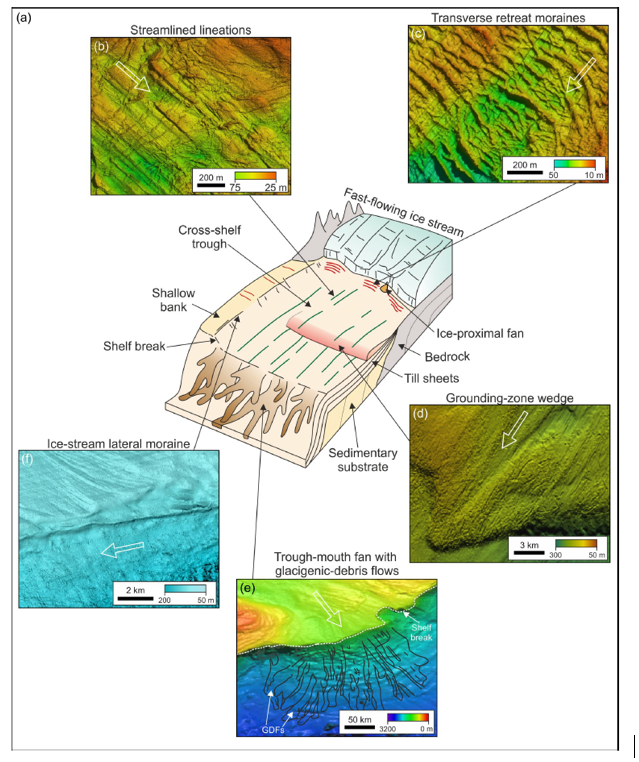
“Ice-stream lateral moraines,” also referred to by the authors as “Lateral Shear Moraines” (LSMs), reportedly form at and mark the subglacial lateral shear zone margins of present day ice streams, between ice streams and slower-flowing regions of a calving ice sheet or tongue. It is believed that the Scarps found here in Vermont represent or are similar and related to LSMs. Whereas these authors describe such features as actual ridges, such ridges generally have not been identified in this 2026 examination, either on LiDAR or in the field. Batchelor and Dowdeswell (2016) focus on the development of ridges but underscore the erosional nature of shear margins. According to one of the authors (Christine Batchelor, 2026, personal communication), it is plausible that lateral shear margins at certain times and places can be dominated by erosion, particularly if the ice is in an extensional ice regime or if meltwater efficiently evacuates sediment. Batchelor referred me to a report by Hindmarsh and Stokes (2007 and 2008), [mfm] Hindmarsh, R. C. A. & Stokes, C. R. (2008) — Formation mechanisms for ice‑stream lateral shear margin moraines, Earth Surface Processes and Landforms 33(4): 610–626. [/mfn] who state that “lateral shear margins of paleo‑ice stream beds are occasionally marked by large curvilinear moraines …. .” (underscore added) It appears that Lateral Shear margins represent a highly dynamic, active erosive and associated depositional glacial environment close to but above the grounding line. For actual ridge moraines to form requires the availability of substantial material to build moraines, sufficient time for their construction and certain, favorable ice flow regimes. It is believed that in Vermont the recession of the calving ice margin was rapid owing to the reverse gradient setting, such that insufficient time and perhaps material, was available for moraine formation. Furthermore, Scarps tend to be associated with the eastern flank of the Trough which is fundamentally relatively steeply sloping terrain, sloping downward to the west with thin soils over bedrock, again indicating that the availability of unconsolidated type material for building moraine ridges was limited.
The following sketch provides a transverse cross sectional profile to illustrate the nature of Scarps, for the main central Champlain lobe, in the “Trough” in late T7 time:
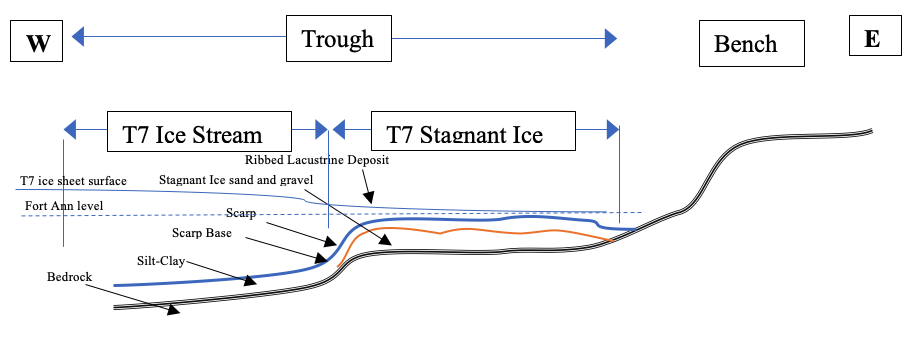
Scarps are believed to have formed, like “Lateral Shear Moraines,” at the margins between ice streams and slower moving ice, with Scarp bases close to but above the grounding line. Most Scarps are associated with physiographic benches, many identifiable as Ribbed Lacustrine deposits, which fits the boundary between fast and slow moving ice. Lateral Shear moraines are close to but slightly above and do not mark grounding lines. Lateral Shear Moraines as reported in the literature extend along the margins of ice streams and thus have longitudinal gradients. The gradients reported for modern ice sheets in Greenland and Antarctica tend to be very low, on the order of 1–10 m/km (5 -50 feet per mile). In Vermont, as noted above, Scarps occur at multiple locations all at approximately the same elevation when adjusted for isostatic rebound, close to but slightly above the Champlain Sea level. The question then is whether or not these Scarps in different locations, as for example in the Bridport, LaPlatte Basin, and Missisquoi Basin all occurred at the same time, or progressively through time as part of the northward ice margin recession. Whereas Scarps tend to be associated with the late T7 margin and in Fort Ann time, these markers themselves are diachronic. It is difficult to establish the timing of formation of Scarps in the Champlain history by the examination of Scarps themselves. However, other features identified in this 2026 re-examination, specifically Transverse Morainic Ridges, as discussed below, provide information suggesting the progressive northward, halting recession of the calving frontal margin.
The nature of Scarps and their appearance on LiDAR imagery are shown in detail in the section of the report below presenting findings from the field study portion of this Addendum. I would add that whereas the focus here in this discussion is on Scarps, in fact as noted above these features occur in association with Ribbed Lacustrine deposits. These deposits in combination led to the recognition and identification of ice stream lateral shear margins associated with the Trough ice stream. However, near the end of this Addendum revisit it was recognized that having delineated this boundary on LiDAR imagery it has become increasingly evident that carefully examined such imagery shows many additional locations along the Trough margin where Ribbed Lacustrine deposits are suggested, flanked by relatively steep west-facing slopes, which are pronounced but lack the sharpness of Scarps. Thus, it is believed that the Trough ice stream is marked by many more features than presently mapped, which greatly strengthen the evidence for this ice stream and its associated calving and rapid recession. As suggested in the Conclusion below, the full story of this recession in the entire Champlain Basin in Vermont and New York deserve further study, both as a matter of deglacial history but as well the nature of ice sheet collapse.
Whereas the discussion of Scarps focuses on the frontal margin of Ribbed Lacustrine deposits, these deposits themselves are of interest. I have tended to think of the Ribbed Lacustrine deposits as simply reflecting locations along basin side margins where ice thicknesses were insufficient to sustain active ice flow and were in fact associated with stagnant ice. However, at a late time in my study of these features, actually when I was in the finishing stages of editing this Addendum, I realized that:
- With careful examination of LiDAR imagery such Ribbed Lacustrine deposits, while very subtle, appear to be much more numerous than I had previously recognized, commonly in the same elevation range of such deposits with Scarps, but including many such deposits even where and when Scarps are absent.
- These Ribbed Lacustrine deposits are marked by ribbing which I have interpreted as having formed by the melting of stagnant ice buried beneath the lacustrine sediment cover associated with the persistence of slowly melting buried ice, essentially an example of Hybrid type margins. However, whereas in some places the Ribbing is chaotic, in a manner resembling and consistent with stagnant ice, in many, likely most places the ribbing consists of relatively straight, evenly spaced ribs, oriented perpendicular to the ice stream flow, with regular spacing, all in manner which seems too uniform for stagnant ice. This raises an alternative possible hypothesis which is that the Glacial Dynamics of lateral shear margins by their nature are associated with less active ice along the margins, which may or may not have been stagnant. This issue has not been resolved.