The map below shows the early T6 time ice sheet (pale gray-blue shading) and ice margin (maroon colored lines):
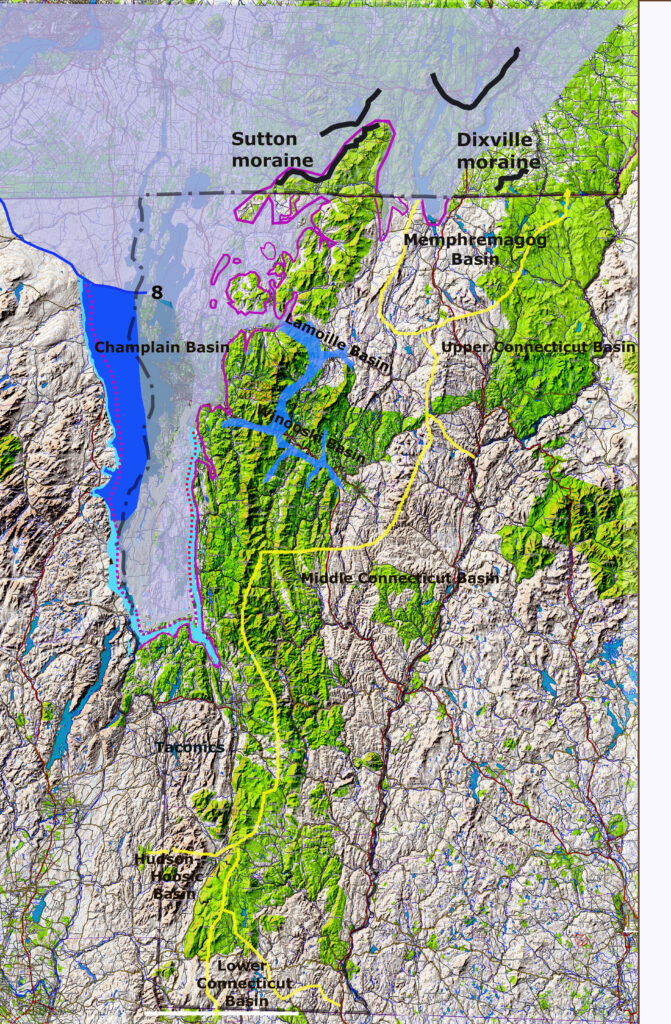
In both the Champlain and Memphremagog Basins the T4, T5, and T6 ice margins represent a step-down sequence, generally of closely spaced hybrid ice margin features, more widely distended in the Vermont Valley. Again, the maroon line on the above map approximately depicts the T6 margin in these basins. Owing to map scale limitations, the position of the early T 6 margin on this map is highly diagrammatic.
By T6 time the Memphremagog lobe had receded to a small, remnant lobe tip in the Newport area, with the ice margin marked by numerous deep kettles which were occupied by remnant ice blocks, interspersed with stagnant ice deposits, including many ice contact deltas related to proglacial Lake Memphremagog. The strandline or footprint for this lake is not shown. Wright(2024, ibid) mapped portions of the Memphremagog Basin in the Newport area in great detail, including the identification of ice margin and proglacial lake features. Whereas he inferred the ice sheet margin based on his interpretation of proglacial water bodies in that Basin he did not specifically delineate deglacial ice margin positions based on a correlation of ice margin features, which is the particular interest here. The recessional history in the Memphremagog Basin in T4 to T6 times is documented by VCGI mapping, as discussed for several Locales in Appendix B.
In the Champlain Basin, again the maroon colored T6 ice margin on the above map, similarly marks the bottom of a step-down hybrid sequence, with stagnant ice deposits, including many kame deltas at the Coveville Lake Vermont level, represented by the neon blue shading along the ice margin perimeter. Again, owing to the map scale, the T6 margin depicted on the above map is highly schematic, with more accurate depictions given by numerous Locales as described in Appendix B. As discussed above in regard to calving, this is identified as a “Disaggregated” ice margin, a narrow, heavily crevassed, “labyrinthian” maze penetrated by standing Coveville waters in a more or less open water corridor.
The early T6 margin and Coveville “corridor” extended northward along the base of the Taconic foothills from the Basin Harbor vicinity, around the nose of the Taconics, into the Vermont Valley in the Rutland/Proctor area, thence continuing northward along the foothills, marked in many places by kame deltas, including the major Coveville deltas at Bristol and South Hinesburg, as discussed above. The former represents drainage from a T6 ice margin at the head of the La Platte Basin, and the latter bydrainage from Lake Mansfield, as marked on the above map, formed by an ice dam at the mouth of the Winooski Basin.
In early T6 time the first phase of calving is suggested along the western margin of the Champlain lobe, related to the substantially greater depths for Coveville waters in the Champlain Basin “Deep Lake” portion of the physiographic “Trough,” as marked by the darker blue color on the above map.
To the north in T6 time, in the Lamoille Basin the early T6 margin is marked by stagnant ice deposits and kame deltas at the Lake Mansfield level. In the Missisquoi Basin, the VCGI mapping shows a highly convoluted T6 margin, marking multiple lobes of thin ice closely related to the physiography, with a major stagnant ice deposit in the Berkshire vicinity. The early T6 margin is correlated with the Sutton moraine in Quebec.
Thus, the early T6 margin marks a long narrow, convex lobe in the Champlain Basin. As discussed above and summarized below, remnants of this lobe persisted in later T6 time, through T7 time, continuing into T8 time. This recessional history was associated with a) the second phase of calving in late T6 and early T7 time, related to the lowering of Lake Vermont from the Coveville to the Fort Ann level, the “Breakout at Covey Hill, the opening of the Winooski Basin as marked by Ice Tongue Grooves for the draining of Lake Mansfield, allowing the invasion of Coveville waters into that Basin, b) the progressively northward extension of a narrow Fort Ann corridor extending into Quebec in T7 time, and c) in turn by recession which allowed lowering of Fort Ann waters to the Champlain Sea, with the third phase of calving, followed by a readvance of the still remaining lobe in T8 time.