Locale MC1 marks the T2 ice margin which extends for a distance of more than 60 miles, from the latitude of Manchester to the latitude of Middlebury, thence eastward for an additional 25 miles, along the western and northern perimeter of the “Middle Connecticut Basin.” This large distance makes it difficult to show the full extent of this margin using VCGI screen shots. The above statewide map, in the discussion of regional deglacial history, shows the T2 margin, and the map below shows the Scabby Terrain which is the focus of this Locale. As with the T1 margin, the Scabby Terrain marks the margin of the Disconnected ice mass, not the margin of the parent ice sheet.

The T2 margin is marked by numerous patches of Scabby Terrain, per the purple shading on the map below. In the southern portion, in the Landgrove, Peru and Londonderry vicinity, the Scabby Terrain patches are substantial and well defined, occurring just below the 2000 foot(610 m) local elevation contour, which corresponds with an adjusted elevation of approximately 2600 feet(792 m). This area was used as a starting point for tracing the 2600 foot(792 m) adjusted elevation “contour” northward so as to define the T2 ice margin. Owing to mechanical difficulty of tracing contours using VCGI, especially in areas of highly irregular terrain, the tracing of this elevation “contour” at the adjusted elevation of 2600 feet(792 m) is very approximate.
Further, the delineation of the Scabby Terrain patches that make up this tract is likewise depicted approximately on this map. Many local Scabby Terrain patches are too small to be drawn on the Statewide map, but can be seen on VCGI maps. For a variety of reasons, the mapping of the Scabby Terrain and the delineation of the T2 margin can be improved by more detailed study.
It is noted that the elevation of the upper boundary of Scabby Terrain patches varies substantially. For example, in the area west of Rochester and Pittsfield, Scabby Terrain patches are at an upper adjusted elevation of about 2200 – 2600 feet, consistent with the elevation of the T2 margin further south. In contrast, a Scabby Terrain patch in the vicinity of East Granville marks an upper adjusted elevation of about 1735 feet, and another near East Braintree is at an adjusted elevation of 1550 feet. Further east in the Chelsea area are patches with elevations of about 1875 to 2000 feet. Further study may indicate that features presently lumped together as T2 time and level can be delineated separately. This might indicate, for example that some areas of Scabby Terrain areas presently mapped in conjunction with T2 time occurred at a later time, indicating Disconnection now designated as T2 actually occurred at multiple times and was progressive.
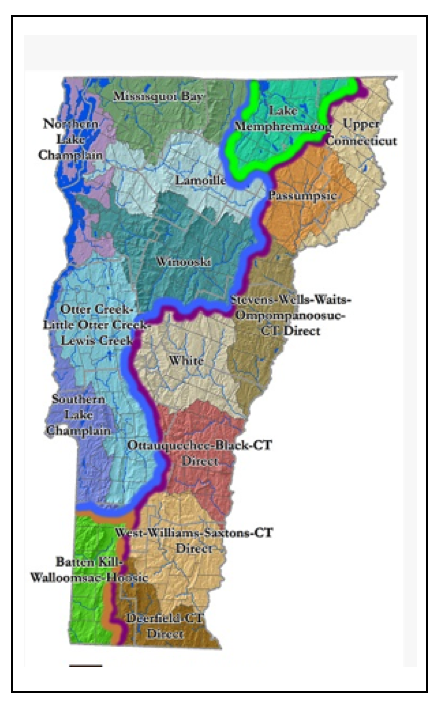
Presently, the T2 margin is taken to indicate a Disconnection of the ice mass in the Middle Connecticut Basin. As shown on the map below this basin includes the present day West, Williams, Saxton, Ottauquechee, and White sub-Basins. The Middle Connecticut Basin lies east of the “Vermont Valley,” which again is part of the Champlain Basin, separated by the relatively high and steep front range of the Green Mountains. For example, the terrain in the area east of Dorset, and in the uplands near Mount Tabor and Peru, rises sharply from the floor of the Vermont Valley eastward to a ridge crest in excess of 3000 feet(local elevation) and over 3500 feet adjusted elevation. To the north, a comparable upland area separates the Middle Connecticut Basin from the Winooski Basin. The T2 margin indicates a Disconnection of the ice mass in the Middle Connecticut Basin from the Champlain lobe.
Ice Marginal Channels document the presence of active ice of the Champlain lobe along the western ridge prior to the Disconnection. Low col divides separate the Vermont Valley in the Champlain Basin from the Middle Connecticut Basin on the west, and the Winooski sub-Basin to the north. For example, three col divides in the Mount Holly area are at elevations ranging from 1863 to 2640 feet adjusted elevation. To the north, multiple narrow drainage ways separate the Middle Connecticut and Winooski Basins at adjusted elevations ranging from about 1230-1320 feet. It is believed that the ice mass in the Middle Connecticut Basin became Disconnected when the level of the ice sheet fell to elevations when and where active ice flow across these cols was no longer possible. It is likely that the Scabby Terrain patches and tracts formed in manner similar to the tract in the Lower Connecticut Basin, with en mass stagnation occurring when the ice sheet elevation lowered to the level and time where and when stagnation of the feeding ice streams across the low cols became insufficient to maintain active ice in the Middle Connecticut Basin.
Much of the area of the interior Disconnected ice mass in the middle Connecticut Basin, as shown on the State surficial geology map, is predominantly thin till ground moraine over bedrock with scattered small stagnant ice deposits in valley floors. Again, and significantly, Ice Marginal Channels which are here interpreted as having been associated with active ice generally are absent over much of this area, indicating the absence of active ice. 1The T1 and T2 Disconnections help to fill out the deglacial history of a large portion of the entire State of Vermont, establishing a framework which can be useful for future research on the details of this history, and as well make connections with research findings in neighboring regions, specifically Quebec, New York, New Hampshire, Massachusetts, and beyond. In this sense, the Vermont story would seem to be pivotal to much of the larger northeastern U.S. deglacial history. The above T2 ice margin Statewide map in Section III of the main report above includes a flowline which is intended to show the sustenance of the Middle Connecticut Basin ice mass ice mass by the Champlain lobe, similar to the T1 time.
Footnotes: