a. Introduction
This study did not begin with the expectation or intent of finding calving ice margins. 1 It turns out that the deglacial history of ice margins, especially calving ice margins, was an exceedingly complex, three dimensional, time transgressive story, made from incomplete puzzle pieces. This complexity for me has been challenging to understand, then to write about, and even now to re-read. I apologize for this, which becomes tedious and difficult to follow. Even though the intent of this section is to simply introduce calving ice margin features I found it necessary to delve into a considerable discussion about the associated history, as a means of explaining the nature of these features. This inevitably makes for a lengthy discussion, lengthier than I would like, with some overlap with the subsequent discussion in a later chapter about deglacial history. The calving margin story suggests that the way I personally have thought about receding ice margins, and I believe more generally as conventionally thought by the larger surficial geology community, represents a paradigm-ic bias that needs rethinking. The resultant story as presented here tries to help flesh out and explore this thinking. This section of my report about calving ice margins could easily and might better serve as an independent report in and of itself. It represents one of the more important findings from my VCGI mapping, not just about deglacial history but as well about global warming. The take-away for me is that the configuration of the physiography of the terrain beneath a glacier or ice sheet, the part we don’t see and find difficult to access in modern glaciers, or in other words the “Bath Tub,” is exceedingly critical to the demise of ice sheets and glaciers faced with global warming. This recognition is not new to me, as has already been reported in substantial literature, but the Vermont story underscores the importance of recognizing and understanding physiography beneath present day ice sheets in this era of global warming. Appendix 4 provides background perspective about how this finding came about. In general, calving ice margins per se have not been mapped previously in Vermont, but as discussed below previously published reports in the Champlain Basin both explicitly suggest the presence of calving or provide information compatible with calving. Different types of calving margin features are identified and mapped in this Basin in this present study. The evidence suggests that calving in the Champlain Basin involved multiple ice streams related to physiography. Calving occurred at different times and locations related to the Champlain Basin physiography and “externalities,” notably the lowering of Lake Vermont from Coveville to Fort Ann levels, and subsequently of Fort Ann to the Champlain Sea level. Further, the evidence indicates that once started, calving was progressive, probably rapid, perhaps beyond a tipping point, leading to the ice sheet’s final exit from Vermont.
Evidence in the Memphremagog Basin, such as bouldery lacustrine silt-clay deposits, is suggestive of possible calving in that Basin. No such evidence was found in the Connecticut Basin. Further study of these two basins in regard to calving is needed, although calving in the Connecticut Basin is unlikely owing to the en masse stagnation of the ice sheet in this Basin for much of its recessional history.
Calving is commonly thought of as causing or resulting in a flattening of ice lobes, with concave indentations in plan view relative to the neighboring, non-calving margins. On the other hand, the lower elevations of Basin floors favors the advancement of ice lobe frontal tips. The interplay between the advancement of the frontal margin versus its recession by calving is a Glacial Dynamic between ice and water. The evidence in the Champlain Basin indicates that this Dynamic favored the development of a long convex ice lobe with a calving frontal tip at multiple ice streams extending southward in central portions controlled by physiographic lows on the Basin floor, with a long, narrow, more or less open, water “Disaggregated” open corridor along its lateral eastern margin.
Further, the evidence indicates that as part of this Glacial Dynamic the history of the recession of the Champlain lobe involved the progressive northward recession of the frontal tip and the northward expansion and widening of an eastern lateral margin open water corridor. As is common with calving, the evidence indicates that the Champlain ice lobe ice was destabilized by calving at the south-facing frontal tip, resulting in rapid northward recession of this ice margin. In addition, the evidence suggests that the eastern margin as well became destabilized by the rapid northward penetration of the narrow, open water corridor, with destabilization of the eastern margin involving its transformation from a lateral to a frontal type margin, entailing a reconfiguration of ice sheet gradients, flow lines, and ice streaming. Thus, while the frontal tip of the Champlain lobe in plan view was flattened by calving, the overall configuration of the lobe shape in plan view remained relatively convex during the recession of the lobe margins, with both northward and westward recession of the Champlain lobe frontal and lateral margins. This history contrasts with the conventional paradigmic way of thinking about the recession of the Champlain lobe, as a more substantially flattened flattened lobe, such as illustrated by the classic work of Chapman and subsequent investigators, which is discussed further below as a “Paradigm Trap.”
Calving ice margins generally are thought of as occurring at the edge of a floating ice shelf where actual calving takes place. And while that is in fact the definition of a calving ice margin, such margins are marked, and thus can be mapped, by deposits and features at and near grounding lines where calving ice shelves are in direct contact with the terrain. The position and configuration of the frontal edge of a calving shelf can be quite different than the grounding line, and likewise the grounding line can be quite different than the adjacent non-calving ice margin. As discussed further below, different types of calving features formed at and mark grounding lines of the calving Champlain lobe.
Further with regard to plan view configurations, grounding lines per se can be either concave or convex, or irregular, and can protrude beyond or be indented behind neighboring non-calving margins, depending on the ice flow and calving dynamics. For example, in regard to the convexity or concavity of calving ice margins, Goliber and Catania(2024) 2 Goliber S. A., and Catania, G. A.(2024), Glacier Terminus Morphology Informs Calving Style; Geophysical Research Letters; RESEARCH LETTER10.1029/2024GL108530, 11 pages. state:
Convexity dominates the identification of different calving styles because floating glaciers experience low basal resistance forcing a transfer of stress to the fjord side walls, creating a concave shape (Cowton et al., 2019). When glaciers are well grounded, this does not occur and ice flux will be largest in the center of the glacier where it is thickest and fastest, creating a convex terminus. Thus, terminus morphology may directly inform floatation conditions for glaciers. As floatation conditions vary over time and space, so too does the terminus morphology and along with it the dominant style of calving.
Reference to the variations in calving terminus conditions in both time and space is significant, because in addition to their spatial configuration variability, calving ice margin positions can be stable, advancing, or receding, and tend to oscillate, with short term, in some cases even daily oscillations related to tidal fluctuations, and as well longer term fluctuations. This is an important observation because it indicates, as has been reported in both studies of modern day glaciers and ice sheets, and as well in regard to Pleistocene records for the Laurentide ice sheet, that calving ice margin grounding line deposits tend to include a mix of materials such as till and interbedded ponded water and fluvial sediments, including structural deformation associated with oscillations. This means that in the study of Pleistocene deposits with calving margins the distinction between oscillations from larger ice margin shifts, including “readvances” of the ice sheet, can be challenging. In this case, both oscillation and readvance evidence is found in association with the calving margin in the Champlain Basin.
Calving ice margins are associated with ice streams, which are faster moving ice within an ice sheet, related to changes in the flow dynamics of the ice sheet caused by or associated with instability. Instability reflects an imbalance and adjustment of ice sheet mass transfer, levels, surface gradients, flow velocities, and flow lines. Whereas calving ice margins tend to be unstable, not all unstable margins are calving. 3As discussed briefly above, ice sheet instability raises questions as to the applicability of the Bath Tub Model and whether calving margins can be correlated with nearby and regional ice margins on the basis of elevation. The evidence indicates that the position and level of the receding ice margin was closely linked to the levels of associated proglacial water bodies. Together strandline features, ice margin features, including both “normal” types and calving types of ice margin features, as described below, show a close correspondence between the ice margin and physiography, supporting the applicability of the “Bath Tub Model.”The evidence indicates that the ice margins of ice tongues penetrating into the Winooski, Lamoille, and Missisquoi Basin mouths (and perhaps as well the Otter Creek Basin mouth) were destabilized by the rapid northward advancement of the narrow eastern open water corridor, but that the frontal margins of ice tongues in these tributary basins were not calving, likely due to inadequate water depths in the standing water bodies impounded by these ice tongues.
b. Review of Previous Vermont Research
The following is a review of previous reports which bear on calving of ice margins in Vermont. It is it is fair to say that it has been generally and widely presumed that calving took place in the Champlain Basin, simply as a consequence of the presence of major proglacial water bodies in the Champlain Basin associated with ice margin recession, which likely were relatively deep, in theory sufficient to support calving. But to date, calving ice margins per se have not been explicitly identified and mapped. As just noted, calving ice margins typically are oscillatory in nature and thus are marked by stratigraphic evidence such as interbedded silt-clay, gravel, and till. However, whereas such evidence has been widely reported in Vermont, the possibility that this may indicate calving margins commonly has not explored. More commonly such evidence has been interpreted as indicating ice margin readvance, which may or may not be the case. The literature review in the following identifies reports which bear on the subject of calving and stratigraphic and/or structrural evudence, even when calving per se is not considered or identified.
It has long been recognized that the receding ice sheet in the Champlain, Memphremagog, and Connecticut Basins was fronted by standing waters. The classic reference on proglacial water body history in the Champlain Basin is by Chapman, who stated: “as the ice front receded a body of water expanded northward in the valley so that the nose of the lobe was continually bathed in water.” This reflects the fact that the recession of ice sheet lobe margins in Vermont were mostly down the regional physiographic gradients, in what today is referred to as a “reverse gradient” setting. Whereas Chapman’s work focused on the delineation of the strandlines of these proglacial water bodies, and not on associated ice margins per se, this simple statement has major implications. If the ice margin was “continuously bathed in water,” as Chapman noted, important questions are raised:
- Where were the progressive ice margin positions in relation to the proglacial lake sequence?
- How are these ice margins marked ?
- What were the prevailing “Styles, ” meaning the environmental conditions at these ice margins?
- How did the ice sheet interact with the standing water, or in other words what were the associated “Glacial Dynamics,” including calving.
Chapman did not specifically address these issues but inferred ice margin positions for the receding ice margins for early and late Coveville, Fort Ann, and Champlain Sea times, based on his paradigm-ic conception about ice sheet recession, showing the progressive northward recession of ice margins positions in a schematic way as shown by his illustrations below:
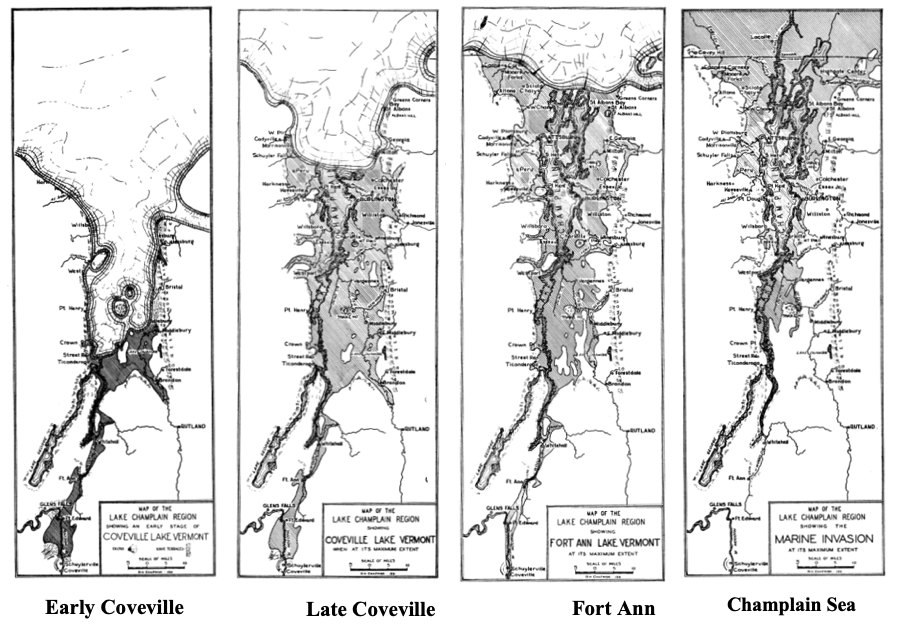
Note that Chapman’s illustrations focus on the flattening of the lobe and do not include the development of a narrow open water corridor. In essence, such illustrations and accompanying discussion reflect and build a conceptual model, basically Chapman’s mental image reflecting his understanding or concept of the progressive ice margin recession in the Champlain Basin. As noted above and discussed below under a separate heading, this mental model represents a paradigm, and as suggested poses a “Paradigm Trap.” Without wanting to detract in any way from what was a major advance in our understanding of late glacial and especially proglacial Lake Vermont and Champlain Sea history it needs to be recognized that Chapman’s model was based primarily on strandlines, with little actual, documented basis for his positions of the associated receding ice margins. For example:
- His early Coveville ice margin position is schematic, based on his conceptual understanding that the early position of the ice margin was somewhere north of the Hudson/Champlain divide, but not on actual specific ice margin features.
- His late Coveville ice margin position is based on his understanding of the northernmost Coveville strandline features, but again not based on actual documented ice margin features.
- Likewise, his Fort Ann ice margin is based on his view that the ice sheet remained in Vermont so as to block the Champlain Sea, not on specific ice margin features. 4 In fact, the evidence presented here indicates that in Fort Ann time, this water body extended northward into Quebec while the frontal tip remained far to the south, again , as suggested by preceding comments, indicative of a long convex Champlain lobe.
- And his Champlain Sea time shows the ice margin to the north beyond Vermont, which is based on his view that the Champlain Basin had become open and ice free at this time in order for the incursion of the Champlain Sea, his mental paradigm leading him to believe that therefore the ice margin must have been far removed to the north. In fact, again the evidence indicates that the Champlain lobe projected far to the south in Vermont in Champlain Sea time, as a long convex lobe. (The influence of paradigms on our thinking, including my own, continues to amaze me. We humans need to formulate mental models in order to think about and analyze information, but these models can lead us to incorrect interpretations. As discussed below, the findings presented here suggest that Chapman’s paradigmic bias was incorrect.)
The drawing of ice margins based on inference from strandline information as done by Chapman is reasonable, based on rationale scientific thinking, but necessarily entails a paradigm-ic model, a preconceived rational way of thinking about the nature of ice margin recessions and how we generally think ice margins should look and should have behaved. 5Chapman’s mind set was and still is broadly shared. I too began this present investigation with this model in mind. We tend to think of ice margins as simple lines on maps indicating progressive northward recession. I have learned that this thinking needs to be revisited. Even now, late in the writing process I find myself repeatedly slipping back into my deeply ingrained paradigmic mind set, as for example that the ice margin was a simple, well defined margin which flattened and receded progressively northward. However, the evidence indicates the receding ice margin was a hybrid type, not like a simple line on a map, and that the Champlain lobe retained and may have increased its convexity during recession, with both northward and westward ice margin recession. This is a much more complex paradigmic mental model that is difficult for me to both grasp and describe. Such is the power of paradigms, which hold us in their grasp. This has enormous significance in regard to our thinking about deglacial history in Vermont, and as well bears significantly on the issue of global warming, as discussed further below and in various other sections of this report. Such inference-based thinking may or may not be correct, but in any case it seems obvious that ice margin features themselves give more direct information. This comment is intended to be an undisguised plug for the “Bath Tub Model” and the benefit of mapping ice margins per se as opposed to relying on inference. It is not meant to be a criticism of Chapman’s (or other subsequent research) inferred ice margin interpretations, but simply a recognition that inferential methodology is less precise and more generalized, and can be incorrect and misleading.
As will be demonstrated, while Chapman’s conceptual model is basically correct in a schematic way, the findings here suggest significantly different, more detailed and specific ice margin positions, associated history, Styles, and Glacial Dynamics. Usage of the Bath Tub Model with VCGI mapping helped to delineate ice margins at different times and places in relation to proglacial water levels, and in fact the evidence indicates that water levels largely influenced, likely even controlled the ice margins, strengthening the case for usage of the Bath Tub Model. This observation applies to ice margins from an early to a late time in the deglacial history for much of Vermont, because a) the ice sheet was sufficiently thinned for much of the deglacial history reported here, relative to the scale of the physiographic relief, so that the ice margins were influenced and ultimately controlled by the terrain, and b) ponded water along ice margins had enormous penetrating power and controlling effect on ice sheet dynamics along ice margins through basic ice/water thermodynamic and physical principles of Physics.
The next major advance in our understanding of deglacial history and information relating to the calving of the receding ice margin after Chapman, albeit again not actual recessional ice margin positions, came from Stewart and MacClintock(1969). Of course, as already discussed previously, these authors had a very different paradigm model in mind about the nature of glaciation and its associated history, one based substantially on stratigraphic and ice movement direction differences, not on the identification, correlation, and delineation of deglacial ice margin positions, including calving positions.
One consequence of their model was that they tended to regard vertical stratigraphic differences as indicative of changing ice sheet movement directions through time, related to their paradigm about glacial history. For example, on page 111 they refer to an exposure in the valley of Lewis Creek where varved lacustrine deposits are overlain by 20 feet(6 m) of glacial till, and another exposure along Little Otter Creek near New Haven where two layers of till are separated by 2 feet(0.6 m) of varved clay. They cite these observations as part of the evidence they use to build a model of glacial history related to three separate glaciations. However, as discussed below, Lewis Creek and Little Otter Creek near New Haven were important locations near Middlebury where the evidence indicates a calving ice margin occurred, possibly explaining such stratigraphic differences in a very different, alternative paradigm way, by a hypothesis related to local ice margin oscillations in a calving setting. Unfortunately, the specific locations of these particular exposures is not given so that independent examination is not possible.
To their great credit, Stewart and MacClintock(1969) identified and mapped the presence of boulders and more generally stones of varying sizes and amounts in proglacial lacustrine and marine silt-clay deposits on the Champlain Basin floor. Such deposits have long been interpreted as indicating a calving ice margin, thought to represent iceberg droppings into proglacial lake or marine bottom sediment. They specifically recognized and suggested the presence of calving ice margins in the Champlain Basin(pp. 160-166, based on the bouldery nature of such deposits in some places, although again they did not identify and delineate such margins at any specific locations. They refer to a ”surprisingly large” abundance of stones in such sediments, so as to “resemble a till plain.” They refer to their State surficial geology map which shows the distribution of both bouldery and non-bouldery lacustrine and marine silt-clay deposits. 6 Based on comments by Connally(1970).who mapped the Brandon and Ticonderoga quadrangles, apparently as part of the then concluding State surficial geologic mapping program, it appears that the bouldery nature of ponded water sediments was determined based on the observations of exposures, and the on the counting of boulders along the margins of farm fields. According to Stewart and MacClintock’s text, the bouldery silt-clay deposits extend northward over a large area on the Champlain Basin floor, northward to the Canadian border, which is likewise shown on their Statewide map, which implied to them that calving persisted as the ice sheet receded northward.
Significantly, Stewart and MacClintock’s State surficial geology map indicates (though they did not so note or discuss in their report) that in the southern portion of the Champlain Basin, their bouldery silt-clay deposits tend to project southward, prong-like, on the basin floor at and below the Champlain Sea marine limit, closely related to its strandline, whereas further north such deposits are associated with both Fort Ann Lake Vermont and Champlain Sea silt-clay deposits all the way northward to the Quebec border. However, silt-clay deposits associated with both Fort Ann Lake Vermont and the Champlain Sea in the main tributary basins, specifically the Winooski, Lamoille, and Missisquoi Basins, are not bouldery on their map. Again, this is likely attributable to the fact that deglaciation and recession of the ice sheet margin was progressive, both from south to north in the main basin and as well from the interior uplands toward the sub-basin mouths, with water depths while ice lobes still occupied these sub-basins being too shallow to support calving.
Stewart and MacClintock refer to what they describe as a virtual absence of till in large portions of the Champlain lowland with lake clays in many places directly lying on bedrock, suggesting to them that the ice sheet may have been calving during both its advance and retreat. This is an intriguing thought, which may bear on the origin and formation of glacial till in Vermont, perhaps with much of it forming at a late time in glaciation. However, this is a topic far beyond the scope of the VCGI investigation here and as well is unrelated to the calving issue.
Part of the field work associated with the development of Stewart and MacClintock’s report and map was done by assistants, whose findings are available online as open-file reports associated with the Vermont Geological Survey. One of these is by Parker Calkin(1960s?) 7 Calkin, P.E.(undated) Surficial geology of the Middlebury 15’ quadrangle; VGS open file report VGS-1, 22 pages. This report is undated but believed to be in the 1960s. It is noted that Calkin was a friend and colleague. He became well-known for his research in Vermont, Alaska, and Antarctica. A glacier in Antarctica is named in his honor. He served as a professor at the State University of New York from 1965-1999. He died in 2017. His passing was of course a loss for his family and friends, but as well represents the loss of an opportunity for his personal input here, which no doubt could have been illuminating and helpful. who mapped the surficial geology of the Middlebury area. As mentioned above, and as discussed below, the “Middlebury Bench” area was especially important for the development of calving ice margins. Calkin’s report indicates:
- P 8: On the east side of Chipman Hill(in Middlebury) are ” kame gravels with sandwiched till lenses.” (This specific area and deposit are discussed further below in the section on VCGI results, as part of the evidence identifying and delineating a calving ice margin.)
- P 13: He identified and studied boulder-rich lacustrine clays, stating: “More than half of the vertical cuts in the deposits show that the boulder clays are varved.” This statement was made to lend support to his view that calving in the Middlebury area was significant, and that such bouldery silt-clay deposits were in fact lacustrine, and not till. Calkin suggests two alternative modes of formation of the boulder-rich clays: 1) ice rafting, 2) overriding of lake clays by ice, as documented in places by varved lake clays overlain by till 8Calkin apparently regarded the presence of till overlying other surficial material in an exposure conceptually as an indication of an oscillation or readvance of the ice margin. It is noted here that till interbedded with lacustrine silt-clay is consistent with calving ice margins, and not necessarily an implication of a “readvance.” His overriding alternative presumably is meant to suggest a readvance, though he does not specifically so state.Importantly, he regards ice rafting as the dominant mode of formation.
- Page 19: “The concept of an oscillating ice front may … account for the interbedding of tills and lacustrine deposits.” Calkin does not elaborate on the meaning and significance of this observation, but presumably by “oscillation” he meant a more local and momentary as opposed to larger and longer term “readvance” of the ice margin.
- P 21: “No moraines are evident in the Middlebury Quadrangle. Interbedded tills and lacustrine deposits suggest that there was probably an active and oscillating ice front in the Lowland area …” Again, this statement is taken as representing his opinion about ice margin conditions, which is entirely consistent with the findings here, as discussed below, that ice margins that developed in the Middlebury area and elsewhere were active ice, calving, oscillatory, and destabilized in nature.
In general, as reported in the literature, ice margin oscillations and calving both tend to be part of the same Glacial Dynamic 9 For example: 1) Benn, D.I., et al, 2007, Calving laws, sliding laws, and the stability of tidewater glaciers; Annals of Glaciology, V 46, pp 123-130; 2) Nick, F.M., et al., 2009, Large scale changes in Greenland outlet glacier dynamics triggered at the terminus., Nature Geoscience, V2, # 2, pp 110-114.; 3) Enderlin, E.M, et al, 2013, High sensitivity of tidewater outlet glacier dynamics to shape; The Cryosphere, V 7, #3, pp 1007-1015. and the resultant stratigraphic and structural features do not necessarily infer ice margin readvance. As just noted, Calkin believed that the evidence he found in the Middlebury area supported calving related oscillations. His report gives specific reference to numerous locations which document his findings and interpretations. Whereas many of these have not as yet been independently field checked as part of the present study, VCGI mapping as discussed below provides substantial evidence of calving in the “Middlebury Bench” in a manner consistent with Calkin’s report.
Continuing with the review of previous research in Vermont in chronologic order, in the late 1960s and early 1970s Wagner (ie., me) mapped the area from the Quebec border southward to the Middlebury area (as published in various reports, but with the recessional ice margin evidence largely unpublished). This mapping showed textural, structural, and stratigraphic variations within glacial till and lacustrine deposits but these were interpreted simply as “normal” variations within such deposits. The presence of clasts within lacustrine deposits was recognized and noted, but a distinction between bouldery and non-bouldery deposits was not made. As noted above, my attempts to identify, delineate, and correlate ice margins of any kind, whether “normal” or calving, were unsuccessful. However, in the Missisquoi Basin, silt-clay and till deposits were identified as a veneer on portions of Champlain Sea deltas, which was interpreted as indicating a readvance of the ice margin. As noted above, mapping by Cannon as part of Stewart and MacClintock’s statewide mapping program also reported similar evidence in this area. Again as discussed below, this readvance is believed to be part of the receding Champlain lobe history, with evidence of both calving and a readvance.
Connally(1970) 10 Connally, G. G.(1970), Surficial Geology of the Brandon-Ticonderoga 15 minute Quadrangles, Vermont; Vermont Geological Survey, Studies in Vermont Geology No 2, 32 p./mfn]mapped the Brandon-Ticonderoga Quadrangles, in the southern Champlain Basin in the vicinity of the aforementioned tongue-like projection of bouldery marine silt-clay deposits mapped by Stewart and MacClintock. 10Whereas Connally refers to the bouldery silts and clays as being “lacustrine,” most of these deposits southwest of the Middlebury area lie below the Champlain Sea limit and thus likely are marine, with the limit of the bouldery silt-clays very closely corresponding with the Champlain Sea strandline. Connally describes his identification of a different type of till in ground moraine on the Basin floor generally in the “lake shore province,” more specifically in the “Otter Creek province.” Glacial till is described in this area as being stony to bouldery with a sandy-loam matrix, as contrasted with till elsewhere which tends to have a clay-loam matrix. He identifies a locality near Bridport where he interprets the till as indicating that the ice sheet overrode “lacustrine” 11Reference to this being “lacustrine” appears to be a generalization in as much as the Stewart and MacClintock map indicates that these silt and clay deposits are below the marine limit.sediment and redeposited the material in a “more or less undigested form.” And he reports two lines of evidence indicative to him of a readvance of the ice sheet:
- A pit exposure near West Bridport which he interprets as indicting that, “bouldery lacustrine clays have been badly contorted, suggesting overriding and incorporation at the base of a glacier.” His Plates 5 and 6 are photographs said to depict till overlying gravel which he interprets as outwash or lacustrine gravel, portions of which are incorporated as shear planes in the overlying till.
- “Ice- rafted boulders present in the lake clay,” generally southwest of Middlebury.
In essence, Connally is interpreting the evidence as indicating a readvance, which approximately corresponds with the bouldery silt-clay soils shown as the projection on Stewart and MacClintock’s map, and in fact this projection likely reflects Connally’s direct input into this mapping. It is believed that Connally’s mapping was part of the Stewart and MacClintock Statewide mapping team, and that his mapping was responsible for some of the boulder silt-clay delineation on the State map. As noted above, Connally describes a method of counting of boulders along tree lines as providing information for delineating bouldery-ness. In a later report, Connally and Cadwell 12Connally, G.G. and Cadwell, D.H., 2002, Glacial Lak Albany in the Champlain Valley, in the field guide for the 71st Annual Reunion, Northeastern Friends of the Pleistocene guidebook, pp B81 – B817. further discuss this readvance evidence, making clear that in their opinion it represented a significant advance of the ice sheet associated with a prior recession of the Champlain lobe. Whereas the evidence for such a readvance as a major historical event has been questioned by subsequent researchers, the photographs given in Connally’s report are impressive, clearly indicating ice margin dynamics. The evidence mapped here on VCGI fits with oscillations associated with a calving ice margin as described by Connally, but neither precludes nor requires a readvance.Interestingly, in as much as both Calkin and Connally were on the same team, we might imagine that their different views may have led to some interesting discussions. From an objective point of view, whereas both interpretations may have merit and are possible, because the concept of a readvance carries with it a more significant implication regarding deglacial history,it is preferable to consider all possibilities before reaching a readvance conclusion. Calkin clearly preferred such caution.
As a side bar:
To be clear, Connally does not specifically recognize, consider, or address calving per se. However, his findings are of particular interest because his work is in the area of the bouldery silt-clay soils projection, within the Champlain Sea footprint, which he and Stewart and MacClintock linked to calving. As just stated, and is repeated here for emphasis, “The evidence mapped here on VCGI fits with oscillations associated with a calving ice margin as described by Connally, but neither precludes nor requires a readvance.” This is such a critical issue that it deserves elaboration, in the context of how my thinking evolved, both in regard to a readvance and the linkagwe to the Champlain Sea.
At an early time in writing this report I tended to be skeptical about Connally’s “Bridport Readvance.” But as just noted, Connally’s evidence suggests “something was going on,” so to speak, in the Bridport area. My early inclination was to suspect this “something” was calving.
Fast forwarding, also as discussed below, I subsequently reviewed the reports of Springston and Wright in the Charlotte area. These authors likewise identified stratigraphic and structural features associated with both interbedded silt and clay soils and sandy soils , which they interpreted as a readvance. Again, I initially suspected that this evidence may instead be related to calving, which likewise was not recognized or considered by the authors as an alternative hypothesis explanation for such deposits. Further, at least some of these deposits are within the Champlain Sea level.
As I was pondering the issue of readvance versus oscillation, and recognized the linkge to Champlain Sea time I also had in mind the evidence that I identified back in the 1970s in the Missisquoi Basin, involving stratigraphic differences, such as interbedded gravels and silt-clays. Such deposits likewise had been identified previously by Cannon. In my opinion, whereas these deposits might represent calving, the fact that they include glacial till overlying Champlain Sea deltaic deposits to me clearly indicates a readvance of the ice margin, again clearly at Champlain Sea time.
Whereas the Connally Bridport evidence and Springston and Wright’s evidence might be interpreted as oscillation related deposits associated with calving, the Missisquoi Basin evidence is more compelling as a readvance. The question then turns to how to account for all three of lese locations associated with ice presence in Champlain Sea time.
In this present VCGI mapping the ice margin associated with the readvance in the Missisquoi Basin is identified as the T8 margin in Champlain Sea time at the marine limit. In my original, early VCGI mapping the T8 margin was traced westward, from the Berkshire and Enosburg Falls area to the Greens Corners area, where Ice Tongue Grooves were identified at the mouth of the Missisquoi Basin. Interestingly, these features indicate early fluvial drainage along receding ice margins at the marine limit, progressing to ice margin positions graded to Champlain Sea deltaic deposits slightly below and therefore younger than the marine limit.
The issue I was then confronting as I was building my understanding was, having demarcated the T8 margin as marking a lobe in the Missisqioi Basin associated with a readvance, where did the ice margin extend. Because my mental model, or paradigm, had in mind calving, it was easy for me to presume that the T8 margin near Greens Corners extended westward across the Basin as a flattened calving margin toward New York State. This was my way of dipensing with the issue, slipping it under the rug so to speak, letting New York researchers deal with the issue of the continuation of the T8 margin. In essence , I was unknowingly operating under the same paradigmic conception as Chapman.
But, I also had in mind the Connally and Springston & Wright. Further, in southern Vermont on the floor of the Champlain Basin in the area west of Vergennes are unusual, suspicious looking features on LiDAR imagery, which were identified as “Ice Marginal Lines.” These features were not back then at that time understood, and their meaning is still uncertain. In time I came to suspect that these may be Mega-Scale Lineations relating to calving. But these are at low elevations in association with Champlain Sea deposits near the marine limit, such that if they are somehow related to an ice margin the implication would be that perhaps the age of the associated ice margin likely would be quite young, perhaps somehow correlated with the Missisquoi Basin T8 margin.
Conceptually, the issue before me was whether the Champlain lobe extended southward on the basin floor as a long convex lobe, with such projection facilitated by the low elevation of the Basin floor – versus alternatively that calving resulted in a receded, flattened ice marin restricted to the north of the Basin. This concept obviously relates to a Glacial Dynamic whereby the ice sheet is driven to extend its margins into lowlying terrain, versus the tendency of calving, if present, to cause substantial recession. In those early days of my VCGI mapping, the calving theory won, such that I drew the T8 margin so as to extend across the northern portion of the basin as a flattened margin, as just stated. This reflected the power of my then existing mind set, or paradigm.
I also was grappling with the realization that the bouldery silt clay soils on the Stewart and MacClintock map were located on the low floor of the Basin in a projection which closely corresponds with the Champlain Sea at the marine limit. This too was a clue.
My original interpretive model as just described began to breakdown in my study of the LaPlatte Basin. As discussed below, the evidence in this Basin documents the development of a T7 calving ice margin for a LaPlatte ice stream, beginning in the headwaters of this basin when Coveville Lake Vermont lowered to the Fort Ann level. Multiple calving ice margin features in this Basin suggest the progressive westward recession of this calving ice margin, down the La Platte Basin, in Fort Ann and T7 time. In his Charlotte report Wright identified an exposure along the LaPlatte River near Spear Street, showing structural deformation of till and interbedded sand, at an elevation which is at or close to the marine limit of the Champlain Sea. My VCGI mapping identified a Ribbed Lacustrine Deposit on LiDAR imagery nearby, just upstream from Wright’s deformation exposure. Field examination by me in 2025 confirmed that this deposit in fact includes a surface layer of silt-clay beneath which is a substantial gravel. My understanding of such deposits is that they mark the ice margin, with a stagnant ice deposit which was left behind with ice still remaining buried within the deposit, when rapid ice margin recession allowed these deposits to become veneered with an overlying silt-clay stratum, again while the stagnant ice still remained, with melting resulting in linear elements in the overlying silt clay material. This is my general explanation for Ribbed Lacustrine deposits, based on my examination of many such features in the 1970s, but especially more recently on VCGI, and by recent field visits.
BUT, this Ribbed Lacustrine deposit is at the downgradient end of the Fort Ann calving ice margin recession, near and just above Wright’s exposure, which is at the Champlain Sea level. Further, an exposure nearby to the west (at the La Berge farm), as discussed elsewhere herein, which was mapped by Stewart and MacClintock as a stagnant ice deposit, was examined in 2025, showing this deposit to be a Champlain Sea delta, with soil evidence of a nearby high energy source (ie, ice)!
Thus, I was struck by an “Epiphany,” regarding all the aforementioned evidence on the LaPlatte, specifically that:
- The Ribbed Lacustrine deposit marked a calving margin formed at the end of Fort Ann time, when the water level lowered to the Champlain Sea level,
- The ice margin at that time was either an oscillatory type calving margin or a readvancing margin, or both, resulting in Wright’s “Deformation Till” and the unusuial deposits in the Champlain Sea delta at the LaBerge farm.
- In fact, the La Platte River itself follows a pattern which is consistent with such an explanation, with the River changing course where it lowered from the Fort Ann floor to the Champlain Sea floor. (Such control of drainage patterns likewise has been noted for Little Otter Creek, New Haven River, and Otter Creek.)
- Thus, the T8 margin likely extended southward to the vicinity of these LaPlatte features. And in addition, the T8 margin likely correlates with the the bouldery silt-clay projection identified by Stewart and MacClintock and as well the “readvance evidence reported by Connally.
This exlplantion does not establish that the ice margin at T8 time in the La Platte Basin was oscillatory as with a calving margin, or readvancing, or both. However, the linkage all of these features at the T8 level and time thus come together, specifically including the evidence of a readvance of the T8 margin in the Missisquoi Basin. Further, the evidence cited by Calkin in the Middlebury area fits with the extension of the T7 and T8 margins southward across the Lewis Creek, New Haven River, and Little Otter Creek Basins, as a readvance inT8 time. Thus, multiple pieces of evidence come together to construct a more robust interpretation of deglacial history for these times and locations.
This sidebar is giving an advance preview of how my thinking evolved on the issue of calving as I was reviewing the literature. Calving is now identified as part of the late T6 to T8 recession, with three separate calving events. And further, this recession was marked by a long lobate shaped Champlain lobe, such that the T8 margin occupied the Basin floor, marked by calving and a readvance in T8 time. This evidence includes the progressive recession of the eastern margin via calving recession in multiple ice streams, as the eastern margin transitioned from a lateral to a frontal margin. At the same time the south facing margin likewise receded by calving, but the Glaciar Dynamic between the ice sheet and the ponded water resulted in the recession from the Brandon area northward in T8 time to the Quebec border, for the ice sheet’s final exit from Vermont. This finding is based on the cumulative input of multiple evidentiary pieces, which together suggest that this recession might be likened to a “collapse” beyond a “tipping point.” This observation reflects the fact that in T8 time the Champlain lobe extended southward to the Bridport vicinity, a distance of about 70 miles, but by the end of T8 time the Champlain lobe in Vermont was gone.
This sidebar is making the point that whereas calving is now identified as part of the late T6 to T8 recession, with three separate calving events. And further, that this recession was marked by a long lobate shaped Champlain lobe, such that the T8 margin occupied the Basin floor, marked by calving and a readvance in T8 time. This evidence includes the progressive recession of the eastern margin via calving recession in multiple ice streams, as the eastern margin transitioned from a lateral to a frontal margin. At the same time the south facing margin likewise receded by calving, but the Glaciar Dynamic between the ice sheet and the ponded water resulted in the recession from the Brandon area northward in T8 time to the Quebec border, for the ice sheet’s final exit from Vermont. This finding is based on the cumulative input of multiple evidentiary pieces, which together suggest that this recession might be likened to a “collapse” beyond a “tipping point.” This observation reflects the fact that in T8 time the Champlain lobe extended southward to the Bridport vicinity, a distance of about 70 miles, but by the end of T8 time the Champlain lobe in Vermont was gone.
Whereas the Connally Bridport evidence and Springston and Wright’s evidence might be interpreted as oscillation related deposits associated with calving, the Missisquoi Basin evidence is more compelling as a readvance. The question then turns to how to account for all three of these locations associated with ice presence in Champlain Sea time. This explantion does not establish that the ice margin at T8 time in the La Platte Basin was oscillatory as with a calving margin, or readvancing, or both. However, the linkage all of these features at the T8 level and time thus come together, specifically including the evidence of a readvance of the T8 margin in the Missisquoi Basin. Further, the evidence cited by Calkin in the Middlebury area fits with the extension of the T7 and T8 margins southward across the Lewis Creek, New Haven River, and Little Otter Creek Basins, as a readvance inT8 time. Thus, multiple pieces of evidence come together to construct a more robust interpretation of deglacial history for these times and locations.
This explantion does not establish that the ice margin at T8 time in the La Platte Basin was oscillatory as with a calving margin, or readvancing, or both. However, the linkage all of these features at the T8 level and time thus come together, specifically including the evidence of a readvance of the T8 margin in the Missisquoi Basin. Further, the evidence cited by Calkin in the Middlebury area fits with the extension of the T7 and T8 margins southward across the Lewis Creek, New Haven River, and Little Otter Creek Basins, as a readvance inT8 time. Thus, multiple pieces of evidence come together to construct a more robust interpretation of deglacial history for these times and locations.
Having given this overview introduction, we can now return to the review of previous literature.Springston and DeSimone (20070 13Springston, G. and DeSimone, D.(2007) Surficial Geologic Map of the Town of Williston; Vermont Geological Survey Open File Report VG07-5. . mapped the surficial geology of the Town of Williston, which is on the northern margin of the “Middlebury Bench.” This mapping was previously referred to as part of the discussion of Ice Tongue Grooves. So far as is known, no report accompanying this map is available. This map includes an area of stratified fluvial sand and gravel along Sucker Brook which is described as follows:
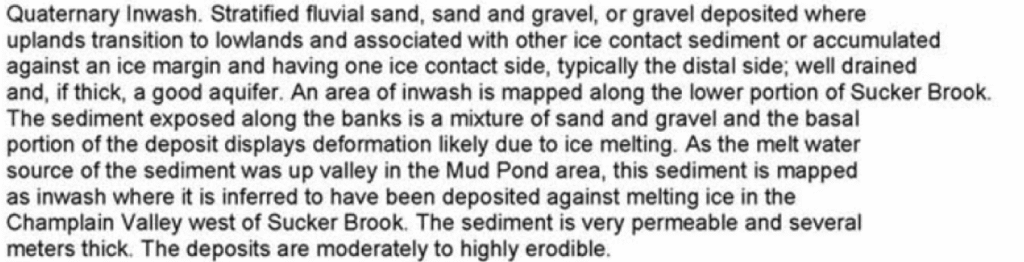
As discussed below, this deposit and an associated deposit further north on Sucker Brook at a higher elevation are here interpreted as kame delta deposits associated with the Coveville and Fort Ann levels related to the calving ice margin in the “Middlebury Bench” area, and the drainage of Lake Mansfield prior to the opening of the Winooski Basin for the invasion of Coveville and Fort Ann waters into the Winooski Basin. While the authors did not suggest calving, this description is included here as part of this review of previous work which is here regarded as supporting calving. Sucker Brook lies along the eastern margin of a small physiographic re-entrant which the evidence below indicates was occupied by a calving ice stream as a small appendage of the Winooski ice tongue. Springston and DeSimone’s mapping fits with and supports this interpretation.
Again it needs to be said that Springston and DeSimone’s work does not explicitly refer to calving, but nevertheless is interesting in that such stratigraphic features as they reported may be related to the calving ice margin story.
Springston and Wright et al and Wright(2009) 14Springston, G. and Wright, S., 2009, Open File Report VG09-6-Surficial Geologic Map of Charlotte, Vermont; VT Geol. Sur.. , 2010 15 Springston, G.. 2010, et al, 2010, Geology and Hydrogeology of Charlotte, Vermont, Vermont Geological Survey, Department of Environmental Conservation, 21 p. This report includes a separate Open File Report VG09-6: Surficial Geologic Map of Charlotte, Vermont, by Springston, G. and Wright, S. pp 16-19, and a separate repot Wright, S. F., Surficial geologic map of northern Charlotte, VT: Report submitted under contract to the VT Geol Sur, VT Dept Env Cons, 11 p. studied the nearby Charlotte area, which is close to and slightly north of Middlebury. The authors recognized soil differences:
- In their description of map units:
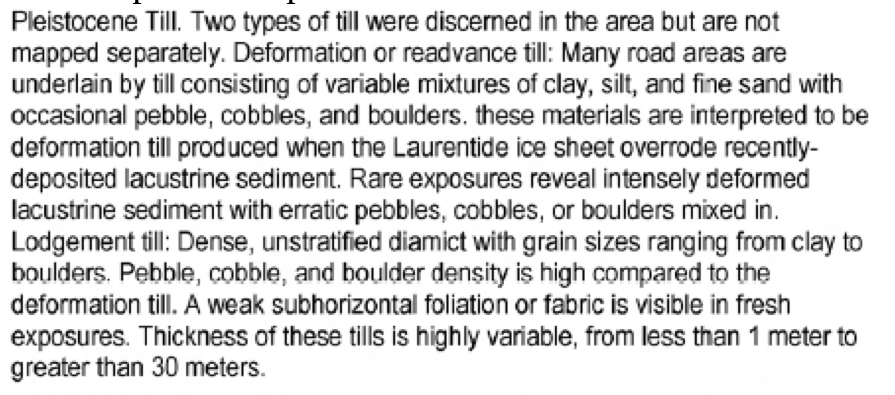
- On p. 2 of the associated Wright report:
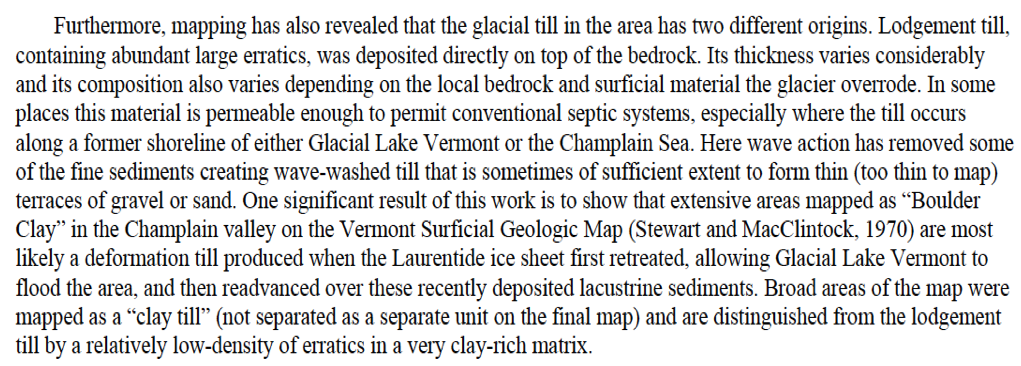
- On page 6 of the Wright report:
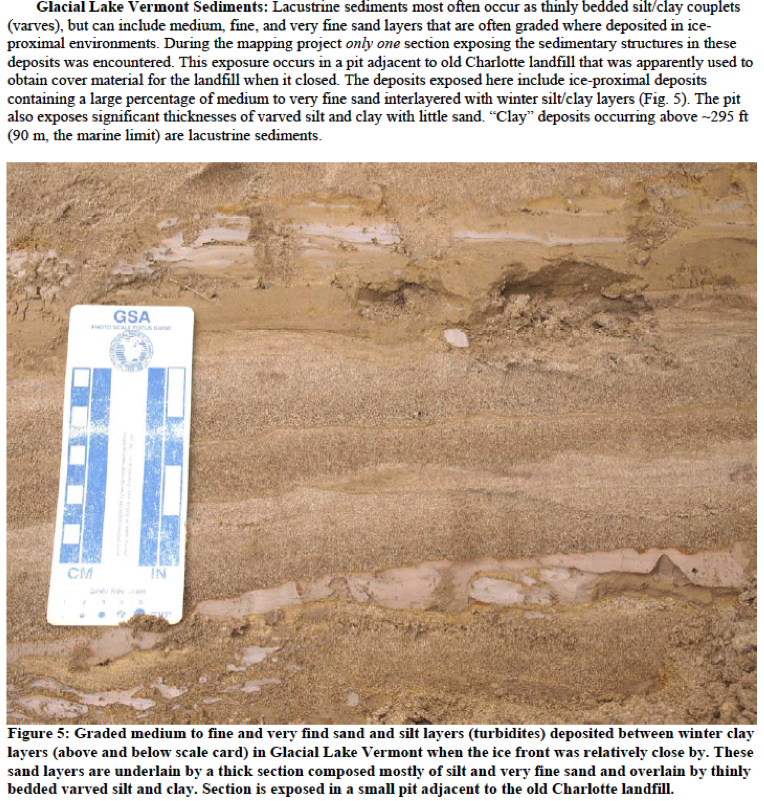
- On page 10 of the Wright report, the author depicts the photo below:
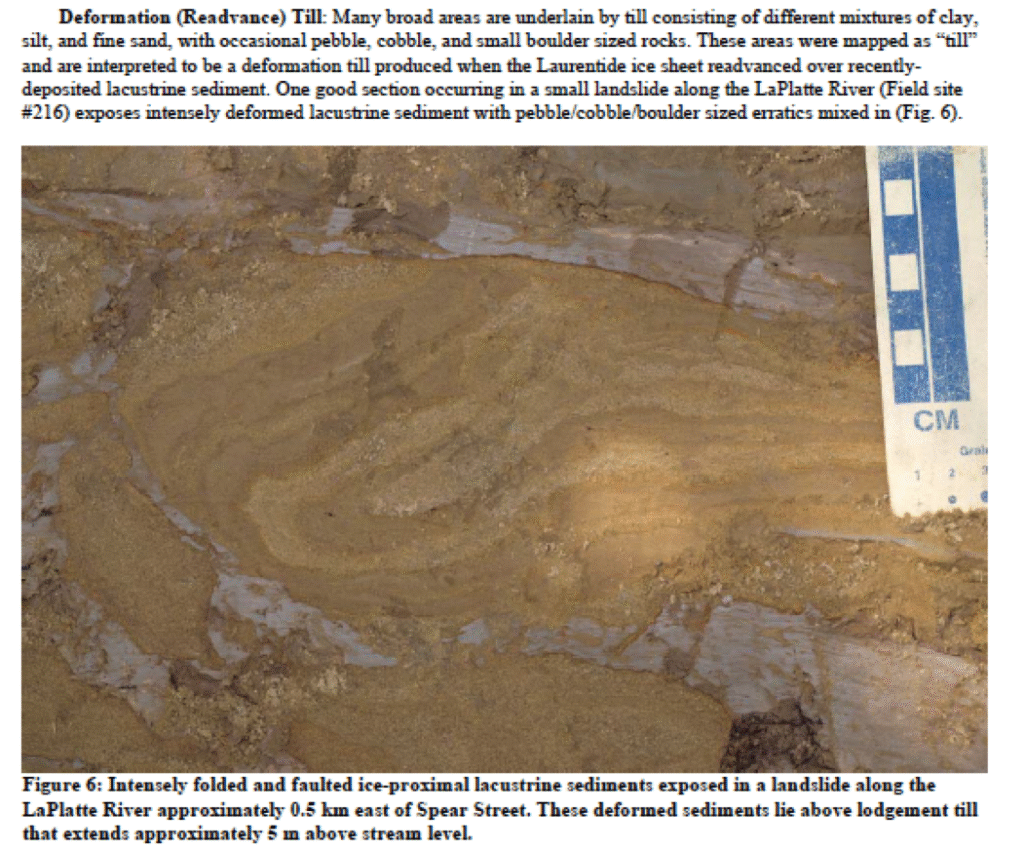
- Wright makes the following statement:
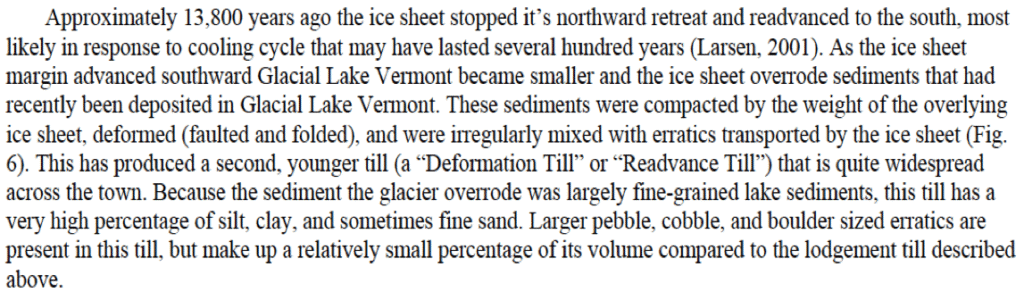
As discussed further below, Wright’s interpretation is believed to be generally correct, but fits as well with both ice margin oscillations and a readvance, though here believed to have occurred in Champlain Sea and not Lake Vermont time as part of the aforementioned long convex Champlain lobe. The type of evidence given by Wright, makes it difficult to distinguish between an ice margin readvance versus ice margin oscillations. However, the evidence presented here in this report from VCGI mapping indicates a correlation of the features described by Wright in the Charlotte area, including specifically along the LaPlatte River, with the evidence presented by Connally in the Bridport area and the evidence presented in the Missisquoi Basin by Cannon and Wagner, greatly strengthens Wright’s interpretation. It is believed that the ice margin readvance was oscillatory in nature during the ice margin recession and/or readvance. Further, Wright correlates this readvance with evidence reported by him and his colleagues in the Winooski Basin, which in turn may be correlated with a readvance associated with the White Mountain Moraine System (WMMS) in New Hampshire. However, the Winooski and WMMS readvances are here believed to have occurred at a previous time, before the readvance associated with the Champlain Sea time features
On page 11 of the Wright report it is stated that the Champlain Sea limit in the Charlotte area is at an elevation of approximately 295 feet(90 m) (which is close to the elevation of his deformation exposure on the LaPlatte near Spear Street), and that, based on soil cores obtained from the Winooski area, the approximate 100 meter drop of water levels from Lake Vermont to Champlain Sea was sudden. The significance of both of these observations relative to the interpretations given here is obvious. The magnitude and suddenness of the change from Lake Vermont to the Champlain Sea is here believed to have been a significant trigger for further ice margin destabilization by calving as a “Glacial Dynamic.”.16The fact that the Champlain lobe calving was associated with multiple times of water level lowering, the first from Coveville to Fort Ann and the second from Fort Ann to Champlain Sea , makes it difficult to definitively establish whether or not the calving recession of the Champlain lobe reached a “trigger point” beyond which the lobe was unable to recover. Further, based on the evidence suggesting that the ice margin in the Missisquoi Basin remained and continued to recede and was still present in later Champlain Sea time when sea level lowered owing to isostatic uplift, suggests that continued recession (including by calving) may have been a response to ongoing water level lowering.
- On page 17 of the Springston and Wright report:
- And on pages 10- 20 of the Springston and Wright report:
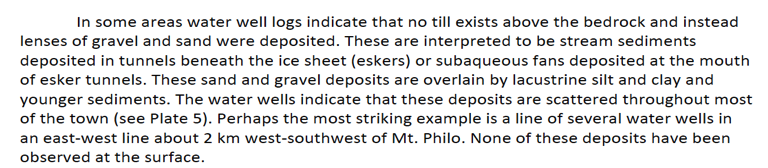
Plate 5 shows an interpretation of the favorability of surficial materials based on a classification of the stratigraphy of the surficial deposits in the bedrock and surficial wells. As shown on Plate 5, the high-yielding wells in surficial materials are generally buried in sand or gravel below thick clays. These wells are scattered throughout much of the town.
In my opinion, the information cited above by Springston and Wright is consistent with and lends support to a calving ice margin with oscillations, but as with the Connally report the evidence does not preclude a readvance.
Van Hoesen(2016) 17Van Hoesen, J.G., 2016, Final Report Summarizing the Surficial Geology and Hydrogeology of Monkton, Vermont; Vermont Geological Survey Open File Report 2016-2, 36 p studied the Monkton area which is southeast of Charlotte and northeast of Middlebury, in the “Middlebury Bench” area. Lacustrine deposits are described(page 21) as “well-sorted, well-stratified silt-clay deposits commonly forming distinctive topography in the valley bottoms.” Van Hoesen’s “distinctive topography” is regarded as significant, as discussed further below in regard to “Ribbed Lacustrine” deposits, giving evidence in support of and indicative of calving ice margins. The author also notes that well logs indicate that sand and gravel deposits occur in some places below the lacustrine deposits. The meaning or significance of this observation, and the presence or absence of boulders in lacustrine deposits is not discussed, but is here believed to be consistent with a calving ice margin, such deposits being commonly reported in the literature related to meltwater basal tunnel drainage at such margins.
Finally, as discussed in Appendix 4, a number of reports have identified ice margin positions in the Champlain Basin in New York, as for example by Franzi and colleagues, some of which have been utilized below in the historical section of this report to illustrate possible regional correlations of ice margin positions. For example, the map below is taken from Van Hoesen et al’s “Ode to Chapman.” 18Van Hoesen, J.G., et al, 2016, A Cartographic Ode to Chapman: A revised regional depiction of Postglacial Landscape Evolution in the Champlain Valley; Geol Soc America Poster Presentation. This map shows multiple ice margin positions extending across the Champlain Basin between Vermont and New York. According to Franzi (2024, personal communication), who was one of the co-authors, he believes that Champlain lobe ice margins in New York, which extend eastward across the basin floor, as for example shown on this map, likely were calving, based on the substantial water depth of Lake Vermont, which supports flattened margins as depicted on the Ode map. But Franzi indicates that the positions of calving ice margins as they cross the Basin floor from New York into Vermont, including positions in Vermont, have not been documented and were drawn schematically, as flattened lobe margins so as to suggest calving. In my opinion flattened ice margins such as depicted on the Ode map reflect a paradigmic model in contrast to the evidence for a long, convex-shaped Champlain lobe as presented here.
The Ode to Chapman map below, represents typical, conventional thinking about ice margins, first that they are represented by simple lines on a map, and second that in the Champlain Basin the recession of the ice margin was from south to north with a flattened lobe associated with calving.
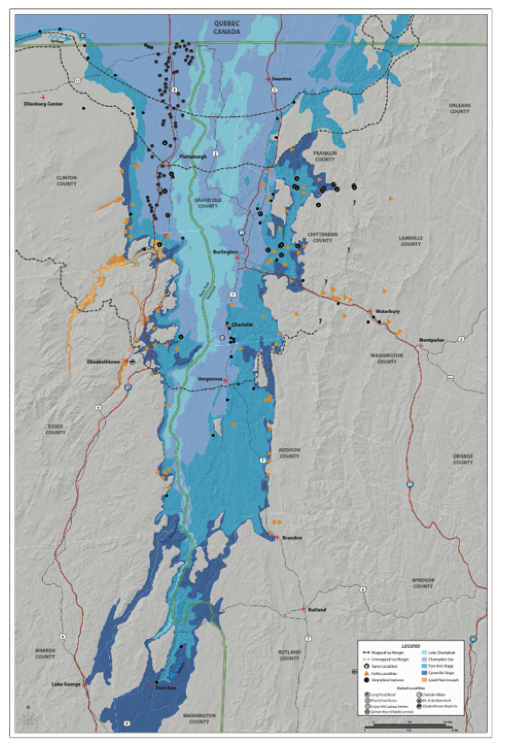
Again, this represents a paradigm that can be seen, for example in the thinking of Chapman, and in more recent reports in Vermont and in Quebec.19This is referred to here in a separate discussion as a “Paradigm Trap.” The evidence here indicates such margins were much more complex, as for example as hybrid margins with both active ice and stagnant ice components. Further, ice margins in Vermont were fronted by standing water, which had a very significant impact on ice margins, first by the development of narrow standing open water corridors or complex crevasse labyrinths of “Disaggregated Margins” along lateral margins as discussed elsewhere herein, which closely followed the physiography, and second, as well by calving which likewise shows and underscores importance of physiographic influences. The configuration of the ice margin represents a major Glacial Dynamic which played out in the recessional history of the Champlain lobe. The effectiveness of standing water along the ice margin is discussed here in regard to calving, but this Dynamic is likewise illustrated by the previous discussions of Scabby Terrain and Disconnections indicating en masse stagnation of ice masses along the Lake Winooski strandline, as discussed above, and by the development of Ice Tongue Grooves. This observation is very significant with regard to modern global warming concerns about the impact on ice sheets such as in Antarctica and Greenland. Whereas VCGI mapping only provides relative time differences and not absolute times or dates for the ice margin recession, the information shows a substantial increase in meltwater, with ponding in reverse gradient settings, suggestive of and consistent with a very rapid recession of the ice margin in the Champlain Basin, with instability, likely but uncertainly beyond a tipping point. The message here for global warming concerns is that penetration of water along ice margin, especially as ponded water bodies coalesce and become more regional, may trigger Glacial Dynamics having major impact on today’s ice sheets. The configuration of the terrain, or “Bath Tub” is important in that regard.
As a sidebar summary commentary related to the preceding literature review and its bearing and significance in regard to the VCGI mapping and associated historical interpretations given here, the following observations can be taken from the above as an advance preview of the deglacial history in the Champlain Basin:
- Whereas previous studies in Vermont have not specifically identified and delineated calving ice margins or set forth a deglacial history, they provide information which is suggestive of and consistent with a calving margin history as developed here and described below. Stewart and MacClintock’s mapping of bouldery versus non-bouldery silt-clay deposits provides information, as they state, that suggests the presence of calving of the Champlain lobe on the Basin floor. Their observation that in places these deposits resemble a till plain is significant. It is not clear from their report where this observation came from but may have reflected a contribution from Calkin in the Middlebury area and Connally further south in the Brandon, Ticonderoga, and Bridport area. Clearly, Calkin was struggling with the meaning of such deposits, but his observation that a substantial number of exposures in such deposits are varved is important, as is his conclusion that whereas stratigraphic variations within these deposits might suggest ice readvance or oscillations of a calving ice margin, his evidence favors the latter.
- In the Bridport area, also on the Basin floor but slightly further south than the Middlebury area, Connally recognized the occurrence of a bouldery silt-clay, which along with the stratigraphic and structural evidence at the West Bridport exposure led him to postulate a readvance of the ice sheet.
- Springston and Wright likewise recognized a bouldery silt-clay material in the Charlotte area, just north of Middlebury, leading to their suggestion of a climatically significant readvance related to a “Deformation or Readvance Till” as distinct from a lodgement till. Unfortunately, they did not depict the distribution of their Deformation Till locations on their map.
- As discussed below, the Hinesburg/Middlebury/Charlotte/Bridport area on the Basin floor was examined as part of the VCGI mapping reported here, including information from limited field mapping, leading to the following observations as related to the previous work just described in the above:
-
-
- A step-down sequence of ice margins at the T4-T6 levels and times leading to Coveville Lake Vermont is mapped on VCGI along the foothills margin of the Basin floor in early T6 time. The evidence indicates that Coveville Lake Vermont then existed in a long narrow standing water corridor, extending northward to the Hinesburg area in early T6 time, with an ice dam across the Winooski Basin resulting in the impoundment of major water bodies, specifically Lakes Winooski and Mansfield in the uplands.
- Three calving events are identified. The first in early T6 time is inferred as a possible calving event related to the lowest “Deep Lake” portion of the Basin floor. If present, this event would be marked by features in New York State and not likely in Vermont. The second calving event occurred in late T6 time when Lake Vermont lowered from the Coveville to the Fort Ann level. This event is marked by many features at the Fort Ann level, including features as just described from the previous work of others, and as well features mapped here on VCGI as discussed below. The third event occurred in T8 time when Fort Ann lowered to the Champlain Sea.
- The second and third calving events, triggered at times of major lowerings of regional proglacial water bodies, were associated with ice streams in physiographic re-entrants within the “Middlebury Bench,” including the LaPlatte Basin where Wright and Spingston’s mapped features in the Charlotte area, the Little Otter Creek/New Haven River basin where Calkin mapped the Middlebury area, the Monkton area mapped by Van Hoesen’s, and the Otter Creek basin and Main Trough of the Basin, including Connally’s mapping, and as well important features mapped on the State map. Also, Springston and DeSimone’s mapping of features in the Sucker Brook basin is in a small but not insignificant re-entrant at the mouth of the Winooski Basin.
- The beginning of the second phase of calving in late T6 time associated with lowering from Coveville to Fort Ann is marked by “Ribbed Lacustrine,” “Thickened Bouldery Silt and Clay,” and “Headless Delta” deposits on the floors of the re-entrants as delineated on the State Surficial Geologic map, and other features as discussed below, extending downgradient from the heads of these Basins. This mapping is in remarkable agreement with, and documents and supports the calving history described here, which is a testament to the careful thinking and observations of Stewart and MacClintock and their field team.
- The progressive recession of the calving margin for ice streams in each of the re-entrants during this second phase is also marked by other calving ice margin features as discussed below. Features identified by VCGI mapping and as well by previous works, by Stewart and MacClintock, by Wright in the LaPlatte Basin in the vicinity of old Charlotte landfill, by Springston and DeSimone at Sucker Brook, by Van Hoesen in the Monkton area, by Calkin in the Little Otter Creek/New Haven River Basin, by Connally in the Otter Creek and “Trough” Basins, and by Cannon and Wagner in the Missisquoi Basin, all correspond with the calving ice margin recession near the end of the second phase of calving at the beginning of the third phase of calving, associated with Fort Ann to Champlain Sea water level lowering.
- Ice margin features indicate the Champlain ice lobe was long and convex in plan view, with calving along the ice stream fronts in each of the re-entrants in late T6 and T7 times, and with a narrow standing water corridor extending progressively northward along the eastern margin, eventually into Quebec, while the ice sheet still projected far to the south in the Basin. The third phase of calving was triggered by the lowering of water levels from Fort Ann to Champlain Sea, associated with invasion of the Champlain Sea in T8 time along this corridor.
- Evidence identified by Cannon and Wagner’s mapping in the 1970s in the Missisquoi Basin indicates a readvance of the ice sheet took place in T8 time. The extent of the ice margin recession prior to this readvance and therefore of the readvance itself, and the climatic significance, if any, are unknown. Nor is it clear if this readvance re-established a freshwater water body above the Sea, though Wagner(19721) offered speculation in this regard. As discussed below, the ice sheet in the Champlain Basin at this time remained as a long, convex ice lobe, with recession taking place as much or more by shrinking of the eastern margin in a western direction as opposed to northward recession. 20 In the final, concluding section of this report, helpful comments by Dave Franzi led to my questioning the nature of this long, convex ice mass. This allows for a correlation of features as described by Wright and Springston and by Connally with the recession and readvance of the ice margin in the Missisquoi Basin, with the recession consistent with an ice margin oscillation and not necessarily requiring a major readvance as proposed by Connally and Wight et al.
- The T8 margin, including the readvance evidence in the Missisquoi Basin is correlated with the features associated with the third phase of calving in the LaPlatte, Little Otter Creek/New Haven River, and Otter Creek and Trough ice streams, again indicating a long convex ice lobe extending southward to the Bridport area, with a long narrow standing water corridor along the eastern margin of the lobe. The correlation of features in the Missisquoi Basin with features as far south as Bridport, was initially regarded as problematical in as much as Wagner’s mapping of many deltaic deposits at the Champlain Basin showed no evidence of readvance in these deposits. This thinking is an example of the danger of paradigm trap thinking in as much it reflects the traditional thinking of the progressive northward recession of flattened ice margins. However, a long convex lobe with a standing water corridor along the eastern margin fits with recession and resolves this conundrum. Such a lobe configuration suggests both south to north and east to west recessional components, whereby the readvance identified in the Missisquoi Basin can be correlated with features to the south without requiring a large north to south readvance over a substantial distance. The nature of the readvance as a significant climatic event, as suggested by Connally and Wright versus a calving ice margin oscillatory event as suggested by Calkin, is unknown but the evidence does not require a more major climatic event.
-
An additional point needs to be made in the context of this literature review, as a kind of sidebar to this sidebar:
In general, the prevailing, traditional view of deglacial history in Vermont is that the recession of the ice sheet and associated proglacial water body history took place as a relatively well-defined, sharp-edged, staccato-like progression of receding ice margin positions through time., much like simple lines on maps. This was not the case. Ice margins were broad, hybrid margins, with complex spatial and temporal relationships during recession. Likewise, the proglacial water body history similarly has been classically viewed as a relatively simple step-down progression of lowering water levels. This understanding of the ice margin and water levels represents a mental model or paradigm. Again as discussed elsewhere in this report, paradigms are fundamental and necessary elements of human thinking but they tend to imbed thoughts and concepts which may or may not be correct. The danger is that our thinking and understanding proceeds without being recognized as such.
Franzi(2025, personal communication) believes and is now in the process of reporting, that the prevailing model or paradigm previously established by Chapman for the Champlain Basin proglacial water body history is incorrect and needs to be revised. His findings indicate that the stair-step recession of water levels as outlined by Chapman is oversimplified, that the levels of these water bodies were temporally and spatially more variable. As noted above, he uses the term “diachronous” to signify his view that the ages of individual strandlines were not everywhere the same.21Wikipedia states: “In geology, a diachronism(Greek dia, “through” + chronos, “time” + -ism), or diachronous deposit, is a sedimentary rock formation in which the material, although of a similar nature, varies in age with the place where it was deposited.” In a sense, this has long been recognized in geologic thinking as embodied in the “facies” concept. This concept fundamentally recognizes that the strandlines formed along the receding Champlain lobe ice margins, which receded through time, must therefore be different ages at different places along the same strandline.
It is here believed that the same thinking applies as well to ice margins. In this report, ice margins are distinguished based on elevation, as though they represent time lines, which has been a helpful way of raveling and constructing deglacial history. However, it needs to be recognized that this is a paradigm which tends to simplify our understanding in order to make it comprehensible, but in the process distorts the resultant historical story.
For example, in this report deglacial history is explored with reference to a relatively straightforward sequence of progressively lower and younger ice sheet levels in a “Bath Tub Model.” These levels thus provide a temporal chronology which define ice margin positions, leading to the usage of the terms and concepts of levels and times interchangeably. However, such levels and their implicit ice margin positions, like strandlines as now regarded by Franzi, were likewise diachronous, because in fact they are not true “timelines”(meaning markers along ice margins which everywhere along the time line are the same age). This fundamentally is because, in part, the ice margins and timelines identified here are imprecise and at best approximations of times,
Further, the evidence indicates that ice margins involved both active and stagnant portions as hybrid margins, and that these receded in tandem, but that owing to their insulating sediment cover stagnant ice margins persisted longer than their active ice margin counterparts. This is referred to in the Memphremagog Basin as a distinctive Style described as “Everything, Everywhere, All at Once and Continuing.” Thus, for example, in the discussion here about calving history, it was found necessary to make a distinction between early T6 versus late T6 levels and times. This distinction in a sense is an acknowledgement that the selection and usage of levels for the deglacial history is not correct in regard to details, and that the Bath Tub Model validity is limited and at best a guide. And while that may be true, the fact is that such chronologies are intrinsically incapable of describing a natural history in which events fundamentally involved overlapping and gradational temporal and spatial elements.
The diachronous nature of both ice margins and strandlines becomes even more complex when one recognizes that Champlain Sea features likely progressed from older to younger in a south to north direction along the ice sheet front margin, but as well north to south in the standing water corridor marking the progressive invasion of the Champlain Sea into the Basin.
In the end, rather than attempting to devise the “perfect” chronology it is preferable to recognize that our understanding of deglacial history is at best a gross artifice which likewise no doubt will need to be revised and refined in the future, as our understanding improves, yet again and again. It seems that the dilemma ultimately relates to the limits of the human mind. Humans are good at thinking spatially in two dimensions, less so three dimensionally, but added temporal complexity challenges the thought process to and perhaps beyond the mental capacity of most mortals. The same applies to reporting, which after all is merely a written communication form of thinking in a two dimensional format. Simple two dimensional concepts can be comprehensibly reported relatively easily and briefly. Adding a third dimension is mechanically more challenging but can be done by clever graphics, still keeping the story relatively brief. Additional temporal complexity, however, strains not only the narrative and accompanying graphical mechanics, but unavoidably adds substantially to the length of reports. For the reader, who is the receiver of the new information presented here, such lengthy discussion which tends to drone-on-and-on in a seemingly unending and repetitive narrative, is a wonderful antidote to sleep problems. We humans have a low threshold for long, convoluted, repetitive narrative, however, essential this may be. It might be true, as has been suggested, that our present day digital age information world places an even greater premium on brevity. All of which is to say here to the readers of this report: “If this applies to you, don’t bother reading on!” As difficult as this may be for you to read and plow through, it is nothing as compared to having to write and then edit such dronings.)”
c. Calving Ice Margin Literature
As is well known, concern about global warming has spurred considerable present-day interest in ice shelves. For example, in 2024 a recently developed research submarine successfully explored conditions beneath the Antarctic’s Dotson Ice Shelf, penetrating about 17 kilometers beneath the ice shelf, showing a variety of never before seen ice margin features and conditions. 22https://en.as.com/latest_news/advanced-submarine-makes-disturbing-discovery-in-unchartered-waters-then-suddenly-vanishes-n/ https://jasondeegan.com/the-ran-submarine-lost-17km-deep-in-antarctic-ice-reveals-the-hidden-side-of-the-south-pole/ These included evidence of accelerated melting at the ice/land/water interface, including subglacial tunnels and widened vertical fractures(crevasses) in the bottom of the ice shelf, and a wide array of sedimentary deposits formed by flowing water at the ice/ponded water interface, as for example “fluvial” dune-like features. Unfortunately, contact with the sub was lost and the mission ended prematurely. Obviously, the sub-glacial calving environment is complex and as yet little understood. This environment is so difficult to study and understand that present day glaciology literature tends to utilize mathematical modeling as a way of better understanding the mechanics of calving ice shelves. But modeling is limited by our imperfect and incomplete understanding, which is dangerous territory for modeling. In contrast, studies of past glaciation, such as in this case for Vermont, allow the examination of ice margin features across a much broader area, and at a fraction of the cost. Of course, both approaches together obviously provide the best information about calving margins.
As just stated, calving ice margins are extraordinarily complex and still not well understood. A complete and detailed review of recent scientific literature on calving, which deals with both the disequilibrium physical dynamics of ice and water along ice sheet margins and as well different types of features found along such margins faced with such dynamics, is beyond the scope here.
In general, calving ice margins obviously and by definition form in close association with proglacial standing water bodies and tend to be oscillatory in nature, with temporal recessions and advances of the grounding line. As a consequence, features formed at calving ice margins show this close glacial and proglacial environmental setting relationship. Many reports indicate an interbedded mix of till, standing water deposits, and fluvial materials originating at meltwater outflows from the ice sheet, which is made more complex by oscillations of the margin, with a variety of geomorphic forms with diverse internal stratigraphic and structural complexities.
Some examples of the literature give a sense of calving ice margin features and evidence:
- As noted above, one of the earliest features reported in the older and now classical literature as being indicative of calving ice margins is ice rafted boulders in lacustrine sediments, such as described above for the “bouldery lacustrine(and marine)” deposits. Such deposits have long and routinely been interpreted as iceberg drop deposits. Thus, extensive and substantial bouldery lacustrine deposits likely indicate the presence of a calving ice margins. Other related features include grooves and mounds caused by iceberg ploughing along shallowing water margins.
- De Geer moraines, which are multiple moraine-like ridges, have similarly been long and classically recognized in conjunction with late Pleistocene coastal ice margins. Different theories have been advanced for their formation, as for example plowing of basin floor sediment by the ice sheet at the grounding line, or upward injection of sediment into basal crevasses.
- Powell 23Powell, R.D., 1990, Glacimarine processes at grounding-line fans and their growth to ice contact deltas; Geol.Soc. London, Special Publications; pp. 53 – 69. identified alluvial fans and deltas as grounding line deposits formed by meltwater outflows at the base of the ice sheet at the mouths of calving ice margin tunnels. This is reminiscent of the descriptions given above from Vermont literature of gravel deposits beneath lacustrine deposits, and may as well be related to “Headless Delta” deposits as described below.
- Davies 24https://www.antarcticglaciers.org/antarctica-2/west-antarctic-ice-sheet-2/marine-ice-sheets/https://www.antarcticglaciers.org/glacier-processes/grounding-lines/ described wedge-shaped deposits at grounding lines, and refers to reverse slope settings, meaning terrain beneath the ice sloping downward in the upgradient direction of the ice sheet, as was the case for the Champlain Basin. As Davies states: “The Marine Ice Sheet Instability hypothesis is that atmospheric and oceanic warming could result in increased melting and recession at the grounding line on a reverse slope gradient. This would result in the glacier becoming grounded in deeper water and a greater ice thickness. This is because the grounding line in this region has a reverse-bed gradient, becoming deeper inland. Stable grounding lines cannot be located on upward-sloping portions of seafloor. Ice thickness at the grounding line is a key factor in controlling flux across the grounding line, so thicker ice grounded in deeper water would result in floatation, basal melting, increased iceberg production, and further retreat within a positive feedback loop. This would result in a rapid melting …. Triggering rapid sea level rise…. Exacerbated by the removal of fringing ice shelves… buttressing ice shelves around ice streams tends to result in glacier acceleration, thinning, and grounding line migration.”
- Sutherland et al(2019) 25 Sutherland, J.L., et al 2019, Ice-contact proglacial lakes associated with the last glacial maximum across the southern Alps, New Zealand; Quaternary Science Reviews V 213, pp 67-92., Kai-Frederik Lenz et al,2024, 26https://www.sciencedirect.com/science/article/pii/S0025322724000331#bb0110 , Lajeunesse et al,2024 27 https://search.app/jodn1KZComwfm79F6, and and Batchelor and Dowdeswell(2024) 28 Batchelor, C.L. and Dowdeswell, J.A. 2024, Ice-sheet grounding zone wedges on high latitude continental margins; Marine Geology, V 363, pp 65-92. likewise describe deposits associated with calving ice margins and grounding lines, including “grounding zone wedges.”
- Orłowska 29https://www.intechopen.com/online-first/1177395 refers to crevasse fill form involving upward injection of till into basal crevasses as ridges associated with surging ice streams.
- Linear features, termed “Mega-scale Lineations”(MSGLs) associated with ice streams at calving margins, have been identified, as for example by: Clark(1993) 30Clark, C.D.,(1993) Megsa-scale glacial lineations and cross-cutting ice-flow landforms; Earth Surface Processes and Landforms; V 18, pp 1-29., Stokes and Clark(2001) 31 Stokes and Clark(2001) First formal definition and mapping of MSGLs; Earth Surface Processes and Landforms, V 18, #1, pp 1-29./mfn], King et al(2009) 31 King et al, 2009, Radar detection of active MSGLs under Antarctic Ice Streams; Nature Geoscience, V 2, pp 585-588,, and Spagnolo et al(2004) 32 Spagnolo, et al, 2014, Global dataset analysis of MSGLs; Earth Surface Processes and Landforms, V 39, No 11, pp 1432-1448. .Such features may correspond with “Ice Marginal Lines,” as identified by VCGI mapping and discussed subsequently below.
- Hudson et al, 2020 33Hudson, T.S. Brisbourne, A.M., White, R.S., Kendall, J.M., Arthern, R. and Smith, A.M., 2020, Breaking the ice: Identifying Hydraulically Forced Crevassing, Geophysical Research Letters, Volume 47, Issue 21; https://agupubs.onlinelibrary.wiley.com/doi/full/10.1029/2020GL090597?utm_source=chatgpt.com, 9 p., suggest that: Hydraulically forced crevassing is thought to reduce the stability of ice shelves and ice sheets, affecting structural integrity and providing pathways for surface meltwater to the bed. It can cause ice shelves to collapse…” Other reports likewise refer to “hydrofracture” as a mechanism causing crevasses to deepen and widen, in some cases to the base of the ice sheet, which then can lead to ice sheet destabilization and calving. This process is influenced or controlled by proglacial water levels which are hydrostatically related to the levels of free water within crevasses in the ice sheet margin. It is here believed that a) the water depths versus ice thickness of the ice sheet on the “Middlebury Bench,” at the time of the Coveville to Fort Ann transition relative to buoyancy, and b) the elevation of the Fort Ann level versus the elevation of the Bench, may have reached a critical point where hydrofracturing may have resulted in the full crevasse penetration of the ice sheet margin, resulting in the development of a destabilized calving ice shelf, with fractures at a receding grounding line or zone. The same may have occurred in conjunction with the Fort Ann to Champlain Sea transition. Both of these events involved substantial water level changes and have been reported in the literature as having taken place suddenly.
d.Physiography – the “Middlebury Bench,” “Western Trough,” and “Deep Lake”
Physiographically, the Champlain Basin floor is low and relatively flat, but carefully examined can be seen to be uneven with significant physiographic differences, especially in the Middlebury area. It turns out that this unevenness had an important influence on the receding Champlain lobe ice margin, in conjunction with Lake Vermont and Champlain Sea water levels, depths, and transitions, as a Glacial Dynamic associated with calving.
This physiography is depicted on the map below, which shows the Champlain Basin from the Burlington area southward to the Brandon area, including the Middlebury area.
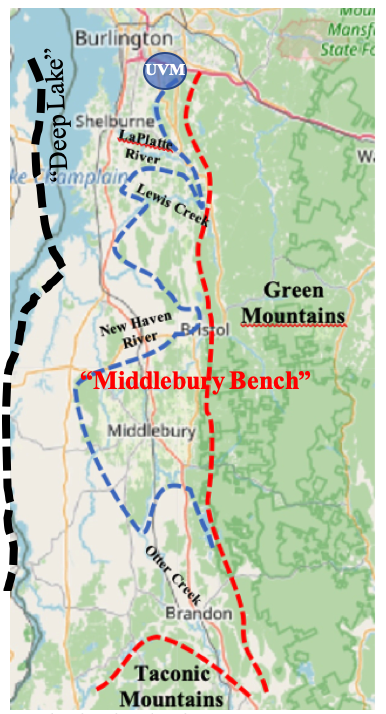
The red dashed lines mark the eastern and southern boundary of the basin floor, along the rise in the physiography associated with the foothills of the Green and Taconic Mountains. To the west and north of this line, very approximately, is the basin floor. The blue dashed line marks an approximate physiographic division of the basin floor into a relatively low western portion, generally below elevations of about 400-500 feet(122-152 m), from an eastern portion with rolling, low topography with elevations generally near 400-500 feet(122-152 m), with knobby terrain projecting above 500 feet(152 m). These are “local, ” not isostatically corrected elevations. The basin floor between the red and blue lines is referred to in the discussion below as the “Middlebury Bench, versus the lower area to the west is referred to as the “Trough.” 34 This physiographic division is very evident and familiar to local residents. For example, driving southward on Route 7 from Burlington to Middlebury the roadway is on the bench, and the lower trough can be seen to the west at many locations.
As can be seen, the Bench is not physiographically uniform but instead is dissected by “re-entrants,” associated with the drainage basins for Otter Creek, New Haven River, Little Otter Creek, Lewis Creek, and the LaPlatte River.35 This physiographic division is very evident and familiar to local residents. For example, driving southward on Route 7 from Burlington to Middlebury the roadway is on the bench, and the lower trough can be seen to the west at many locations.
More substantial, local, mountainous upland nobs occur at the mouths of these re-entrants, including for example Snake Mountain, Buck Mountain, Shellhouse Mountain, Pease Mountain, and Mount Philo, none of which are identified on this map owing to scale limitations. These uplands became nunataks as the ice receded, and likewise became islands in Lake Vermont and the Champlain Sea. Physiographically, these uplands served as funnel-like openings of the re-entrants for ice stream pathways.
The physiographic boundary between the Trough and the Middlebury Bench is marked by a significant slope in the terrain, which, while not precipitous, in many places tends to be a pronounced riser, which as well is locally marked by relatively substantial upland nobs on the western boundary of the Middlebury Bench, as just noted.
The “Trough” itself likewise is not flat and uniform, but can be physiographically divided into two portions. Whereas much of the floor of the Basin Trough is relatively flat, with topography ranging in elevation between about 100 to 300 or 400 feet(30 – 122 m), the floor of Lake Champlain itself includes a substantially deeper Basin floor, referred to colloquially by local residents as the so-called “Deep Lake,” with lake depths in excess of 300 feet(91 m) below the present day Lake Champlain level, which is at an elevation of about 100 feet (30 m) above sea level. As shown on the above map, the thalweg of the “Deep Lake” extends from near Ticonderoga northward, generally along the New York and Vermont border, to the vicinity of the Champlain Islands(South Hero, Grand Isle, North Hero, and Isle LaMotte).
In general, the evidence, as discussed below, indicates that ice streams associated with calving ice margins were associated with the Basin floor physiographic differences as just described, including the re-entrant basins in the Middlebury Bench, and the Trough, with a suggested distinction between the higher “Trough” floor versus the “Deep Lake” portions. As discussed elsewhere herein, these physiographic differences, as presented on maps, when actually seen on the ground, as for example from the vantage point of the traveler, are actually quite profound, making it easier to imagine and understand how the thinning and receding ice sheet must of necessity have “struggled” to cope with such terrain. Seeing these terrain differences in the field, on the ground, in reality, and not just on maps, best if by hiking or biking, makes it easier to comprehend, for example, why and how the ice sheet formed a tongue at the mouth of the Winooski Basin in that the floor of this tributary presented a low, unobstructed if narrow pathway for the development of the Winooski ice tongue. The same can be said, to cite another example, for the terrain at the mouth of the Otter Creek Basin, between Buck Mountain and Snake Mountain, with the relatively low elevation and and low gradient floor of the Otter Creek Basin, representing an “invitation” for the ice sheet to develop an ice tongue in that basin.36 Whereas the physiography in the area generally south of Vergennes is not majestic as in the sense of mountainous terrain, but when seen by the hiker, biker, or driver, associated terrain differences are very substantial. This makes it easier not just to comprehend how but also why the Champlain lobe in its recession bifurcated into two sublobes as marked by evidence on the floor of the main basin southwest of Vergennes and the nearby floor of the Otter Creek Basin. This further helps to better understand the meaning and significance of features identified by remote VCGI mapping, as for example the linear ice margin features on the main basin floor southwest of Vergennes and as well on east flank of Snake Mountain. This type of perception from on-the-ground real world field observation is an argument for one of the benefits of field mapping. Similarly, such real world, direct observation, makes it easier to comprehend the occupation of re-entrant basins in the Middlebury Bench by ice streams. Such seeing is not proof, but makes believing the truth of the findings easier to comprehend and accept as making eminent sense.
e. Calving Ice Margin Feature Types
The following is a summary description of different types of calving ice margin features which mark the calving ice margin and associated ice streams. 37It is noted that an additional set of features perhaps should be added. As just discussed in the preceding and again in a subsequent section on “Ice Marginal Lines,” such Lines northwest of Snake Mountain on the Basin floor near Vergennes are suggestive of Wedges or Megascale Lineations, which are calving ice margin features recognized in the literature. However, the origin of these Lines as yet remains uncertain, requiring further study, and thus they are not included here. Similarly, linears on the east flank of Snake Mountain likely represent portions of Ice Tongue Groove features . Whereas both of these areas require further study, my bias and suspicion is that these features are related to the calving Champlain lobe, as reflected in the discussion below.
1) Thickened and bouldery Lacustrine and Marine Deposits
Silt-clay deposits in some places on the floors of the Champlain Basin trough and the re-entrant basins and sub-basins are marked by and associated with remarkably flat terrain on re-entrant basin floors, suggesting that theses deposits are unusually thick. That this is the case for several of these has been documented by some of the aforementioned previous studies. Also, as just noted these deposits are mapped on the State Surficial Geology map as “bouldery,” which as discussed above is classically recognized as indicating calving. In the 1970s I noticed and mapped but did not understand the origin and significance of these flat basin floors. These deposits are believed to have been associated with and formed by sediment supplied by, at, and near the calving margin of ice streams of calving ice margins, with the thickened and bouldery character due to the delivery of more substantial material by the associated ice streams. Further, it is believed that these deposits formed along the calving ice margin at the grounding line as it progressively receded down the re-entrant ice streams.
The following screen shot is from the VCGI map Project Sheet for the Hinesburg area in the LaPlatte re-entrant:
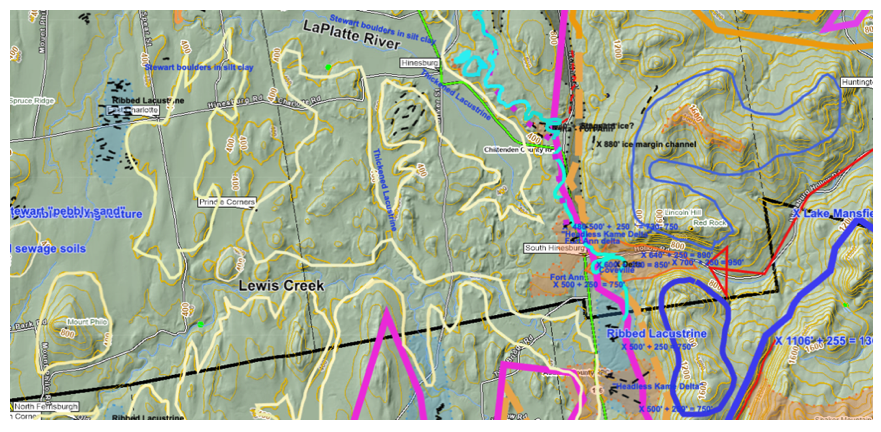
For locational reference, the village of Hinesburg is located in the north-central portion of the map. The yellow lines were marked to indicate the 400 foot(122 m) contour and the bright blue line traces the 500 foot(152 m) contour. The floor of the LaPlatte Basin in this area is unusually flat-bottomed and pronouncedly so, slightly sloping downward toward the northwest. Whereas post-glacial erosion in most places in Vermont has resulted in slight incision into drainage basin floors, the floor of the LaPlatte is conspicuous for its flat bottomed sub-basin portions, which are interpreted as having formed from heavy deposition from a calving ice margin of the LaPlatte ice stream as it generally receded northwestward in a downgradient direction in this basin re-entrant. A more complete description of this interpretation and the associated deglacial history is given in the subsequent section below, for Locale W1 in Appendix 2, and in the more detailed discussion of calving in Appendix 4.
As discussed in the preceding, Springston and Wright identified a “Deformation Till” in their mapping of the Town of Charlotte, which they suggest was formed by a readvance of the ice sheet over Lake Vermont lacustrine silt and clay deposits. In a separate report related to that work Wright cites an exposure on the LaPlatte River of deformed lacustrine material which he suggests provides direct evidence of a readvance. As discussed above and in more detail below, a different interpretation of this particular exposure is given, related to calving. In 2025 this area of the LaPlatte was examined, leading to the recognition of lacustrine soils which in places are stony, but not uniformly so, including a kamic area with a lacustrine cover. This is believed to be part of a deposit identified nearby as Ribbed Lacustrine. Unfortunately, Springston and Wright did not present the map distribution of their Deformation Till. However, it is believed that their recognition of this material as a distinct geological unit is correct, but that this material, like the LaPlatte deformation exposure, instead alternatively may be related to a calving margin. As noted above, this third calving event, associated with the Fort Ann to Champlain Sea transition may have involved an oscillatory readvance which perhaps was more substantial.
This is an example of the merit of field mapping over remote study and a limitation of LiDAR and VCGI imagery which is incapable of distinguishing the soil differences such as between lodgement till and Springston and Wright’s “Deformation Till.” It is not suggested here that all of Springston and Wright’s “Deformation Till” corresponds with Ribbed Lacustrine deposits and/or thickened, bouldery deposits, but rather is a recognition that their observation of till differences likely has merit, albeit possibly related to calving ice margin oscillations rather than a readvance per se. (For me, it is the correlation of Wright’s evidence with the T8 ice margin and the evidence of a readvance of this margin in T8 time, that establishes a bona fide readvance.)
2.) Ribbed Lacustrine Deposits
Also in the same and neighboring re-entrant areas are other deposits which I likewise recognized and mapped in the late 1960s and early 1970s, but at that time again did not understand. These possess strongly kamic topography with more or less parallel topographic grooves, or swales – hence the name “Ribbed Lacustrine Deposits.” One example of such a deposit as identified in the 1970s is immediately south of the South Hinesburg delta complex on the above map. Another is in the Monkton area near the Bristol delta. These are large features, spanning several hundreds of acres on the basin floors. The owner of the South Hinesburg property reported test pits penetrating through about 15 feet(5 m) of an upper layer of fine grained silt-clay sediment into sand and gravel, which likely is the stagnant ice deposit which gives the deposit its ribbed and kamic topography. It is believed that stagnant ice formed the gravel deposit, with submergence of the deposit by ponded waters related to rapid calving ice margin retreat, with burial of this ice and associated gravel material with ponded water sediment, while the buried ice continued to melt, its drainage resulting in the ribbing.
As noted above, Van Hoesen 38 Van Hoesen, J., 2016, Final Report Summarizing the Surficial Geology and Hydrogeology of Monkton, Vermont; Vermont Geological Survey Open File Report 2016-2, 36 p. studied the surficial geology of the Monkton area, showing that surficial deposits on the lowland floors, basically the areas here mapped as “Ribbed Lacustrine,” are predominantly lacustrine silt-clay, but that well logs indicate the presence of a sand and gravel deposit at depth. His isopach map shows substantial thickness on the order of 100+ feet(30 m) of surficial material on the basin floor, again in the area corresponding with the Ribbed Lacustrine feature. Topography in the area of the Ribbed Lacustrine deposits is described by Van Hoesen as: a) “hummocky,” b) having “distinctive topography in valley bottoms,” and c) “characteristic dissected lobate topography associated with lake clay deposits.”
Again, it is believed that these Ribbed Lacustrine deposits were formed as stagnant ice features along the calving ice margin, with the lacustrine sediment cover associated with invasion of Lake Vermont, in the South Hinesburg and Monkton cases, during the Coveville to Fort Ann transition, while melting ice remained in the stagnant ice deposits. The drainage of meltwater from buried ice resulted in the formation of the rib grooves.
Numerous deposits are mapped as possible Ribbed Lacustrine features on VCGI in the area of the Middlebury Bench. These are in areas of silt-clay soils, with ribbing evident on LiDAR imagery, and tend to be associated with the Coveville to Fort Ann and the Fort Ann to Champlain Sea transition. However, many of these may be normal lacustrine deposits with postglacial erosional surface drainage swales, and require further study to establish the characteristics as just described. As indicated in the preceding, a Ribbed Lacustrine deposit along the Lower LaPlatte was identified using LiDAR, indicating the final phase of Fort Ann calving in that Basin, where and when Fort Ann Lake Vermont lowered to the Champlain Sea. This is quite significant as it establishes ice presence, just as Wright’s nearby “Deformation Till” likewise indicates ice presence in my opinion associated with the Champlain Sea. Follow-up field examination of exposures and a water well log in this Ribbed Lacustrine deposit in 2024 and 2025 confirmed the presence of stony lacustrine soils, including kamic topography, and underlying sand and gravel materials.
3.) Headless Shoaling Kame Deltas
Multiple shoaling type deltaic deposits are mapped on VCGI at the Fort Ann level in the LaPlatte, New Haven, and Otter Creek re-entrants, where they occur in close association with Ribbed Lacustrine, thickened, bouldery lacustrine deposits, and stagnant ice deposits. For example, one such delta is associated with drainage from Hollow Brook, as the lowest, fourth level of the South Hinesburg delta at the Fort Ann level. Similar deltaic deposits at the same level are quite prominent along the margins of the re-entrant in close association with stagnant ice deposits,again all at the Fort Ann level.
LiDAR imagery indicates that the sediment in many of these deposits originated from drainage related to stagnant ice deposits, fringing the re-entrants, again suggestive of remnant meltwater drainage. These are unlike conventional deltaic deposits, which narrow in an upgradient direction into the mouths of the associated present-day drainage basins. LiDAR imagery suggests drainage from stagnant ice masses along the re-entrant perimeter, some of which are now buried beneath lacustrine deposits as Ribbed Lacustrine features, toward and into the shoaling deltaic deposits on the re-entrant floor. These deposits are referred to as “Headless Deltas,” which are part of the calving ice margin story.The following is an enlarged portion of the above map showing a Headless Shoaling Delta deposit in the South Hinesburg vicinity.
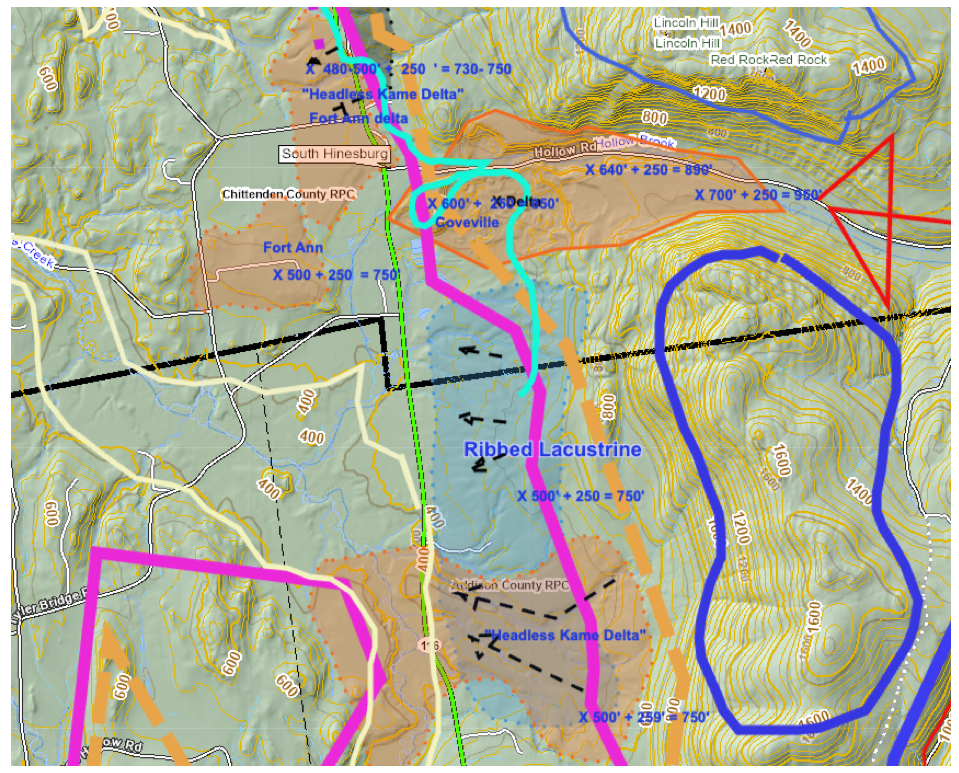
The South Hinesburg Hollow Brook delta is marked by the russet colored area. As discussed below, this delta represents four discrete strandline levels, including two higher levels associated with local proglacial water bodies, a third level associated with Coveville(and as well drainage from Lake Mansfield), and a fourth level at Fort Ann. The blue, orange, and maroon lines represent the T4,T5, and T6 ice margin levels and times.
The map depicts a “Headless Kame Delta” which is at the T6 level and time, with the surface of the delta graded to the Fort Ann level. Also, as can be seen, immediately to the north of this deposit is the aforementioned Ribbed Lacustrine deposit. As discussed in a subsequent section on deglacial history it is believed that the T6 margin was located approximately along the maroon colored line when Lake Vermont lowered from the Coveville to the Fort Ann level. The Headless Delta deposit is believed to have formed from drainage associated with masses of stagnant ice left behind at the T6 level and time, as indicated by LiDAR detected drainage lines. Unlike conventional deltas deposits which tend to narrow upgradient into apexes associated with present day drainage systems, this deposit is not associated with any significant present day drainage which could explain the deposit in a more traditional way. Many such deposits are mapped in this and other re-entrant sub-basins in the Middlebury Bench.
“Ribbed Lacustrine deposits” and “Headless Deltas” are not actually calving ice margin features per se in that that they did not form at the calving margin grounding line but instead formed in close association with calving margins. They represent transitional features associated with the sudden lowering of water levels, such as the Coveville to Fort Ann and Fort Ann to Champlain Sea transitions, both of which were “externalities” independent of the ice sheet control.
In addition to the above, other features as previously described related to the calving history have been identified, including Ice Tongue Grooves, a “Wave Washed Till” deposit and other features related to the leakage of Lake Mansfield, and possibly the Shattuck Mountain Pothole tract. These are not identified here specifically as calving features, but are part of and support this history and the identification of the above as bona fide calving margin features. Again, the Ice Tongue Grooves and the Shattuck Mountain Potholes merit further study before they can be relied upon as part of the definitive evidence for the deglacial history as just described. Further, as already noted, features referred to as Ice Marginal Lines have been mapped on VCGI in many places. These are not fully understood, but may relate to calving, as discussed in a separate section below.
f. Evidence for calving ice margins in the Middlebury Bench area
1)Overview
VCGI mapping provided considerable information about the above described calving ice margin features and the associated deglacial history in the Middlebury Bench area and the central and southern Champlain Basin more generally. Calving was in three phases:
1. The first phase in the lowest, “Deep Lake” portion of the Champlain Basin floor is uncertain and not documented, but is raised as a possibility, based solely on the suspected large water depths related to early Lake Coveville in early T6 time. If present, the evidence for such calving likely would be found in New York, and not in Vermont. 39 Which is my way of asking for help from researchers across the “pond.”
2. A second phase associated with the lowering of Lake Vermont from the Coveville to the Fort Ann level in late T6 time, is marked by many calving ice margin features documenting the progressive recession of calving ice margins in the Middlebury Bench re-entrant basins, including LaPlatte River, Little Otter Creek, New Haven River, and Otter Creek, from a late T6 ice margin position at the head of each of these basins to downgradient positions in these basins at the T7 position, all in Fort Ann time. This phase was also associated with the draining of Lake Mansfield and the breakout at Covey Hill of Lake Iroquois in the Ontario Basin to Lake Fort Ann in the Champlain Basin, both of which may or may not have contributed to the calving.
3. A third calving event in T8 time was associated with the lowering of water levels from Fort Ann to the Champlain Sea at the marine limit, at the T8 ice margin positions which have been identified in the Missisquoi Basin, and further south in the Champlain Basin, in the LaPlatte Basin and on the main basin floor near Bridport.
To help the discussion of calving ice margin history in the Middlebury Bench, and to illustrate the supporting documentation for these interpretations, the map below left (Map A) gives a detailed physiographic perspective of the Middlebury Bench area and on the right (Map B) shows geological features, itemized by numbers, with geographic locations referred to below by letters. Both Maps A and B show essentially the same areas.
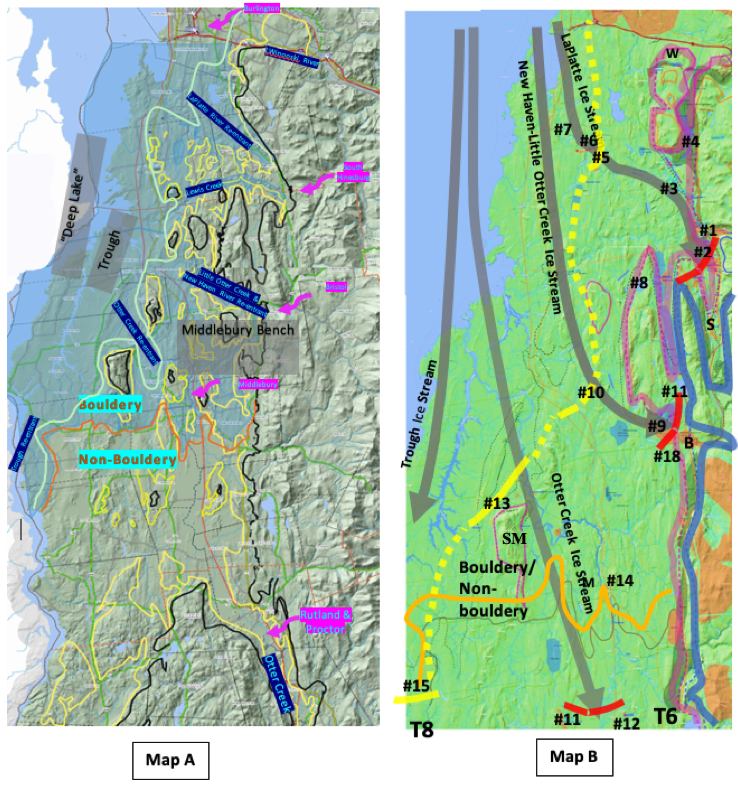
Regarding Map A, elevations are given by contours which are approximately drawn from VCGI maps: a) black line = 500 foot(152 m)contour; b) yellow line = 400 foot(122 m) contour; c) sage colored line = 300 foot(91 m) contour. The elevation of present day Lake Champlain shoreline is at about 100 feet(30 m), and again the “Deep Lake” reaches water depths on the order of 300+ feet(91 m). These are present day elevations but give a sense of the physiography in late glacial time prior to isostatic rebound.
The contours on Map A illustrate the re-entrants and some of the many island-like (bedrock controlled) knobs on the Bench. In general, these physiographic contours closely relate to deglacial history, specifically for calving of ice margins of ice stream grounding line margins in the re-entrants, at the Coveville to Fort Ann and Fort Ann to Champlain Sea transitions. As stated above the evidence indicates that these standing water level lowerings were associated with a Glacial Dynamic that induced calving.
These strandline levels, which of course are not now flat due to isostatic rebound, can be inferred from the elevations on Map A. The Fort Ann strandline is in the range between the 400-500 foot contours. The Coveville Lake Vermont generally mimics the Fort Ann strandline, but of course at slightly higher elevations. The Champlain Sea strandline at the marine limit is approximately marked by the sage colored line, at elevations of about 300 feet (91 m).
The T4-T6 step-down sequence of ice margins, which is mapped on VCGI as extending along the base of the foothills for the Green Mountains and the Taconics, along the margin of the Basin floor, is depicted on Map B by the blue T4 and the maroon T6 lines. The T4 margin is marked by the blue line, the T6 margin by the maroon line, and the T8 margin by the yellow line. In order to minimize clutter the T5 and T 7 margins are not shown.
Also depicted on Map B are gray colored arrows representing ice streams associated with calving ice margins. Not shown on Map B is the full extent of the ice lobe which extended eastward into the Winooski Basin, beyond Map B to the east. Whereas calving likely did not take place in the water bodies dammed by the Winooski ice lobe (Lakes Winooski and Mansfield) owing to insufficient water depth, the Ice Tongue Grooves at the mouth of the Basin suggest destabilization as was associated with calving elsewhere in the Middlebury Bench, such as the LaPlatte re-entrant.
The LaPlatte ice stream may as well have been fed by a sub-lobe extending southward from the Winooski Basin in the Muddy Brook Basin, including features identified by Springston and DeSimone along Sucker Brook, but this feeder lobe is not delineated on Map B.
Evidence of a separate and distinct ice stream for the Lewis Creek re-entrant has not as yet been identified. Likewise, ice streams for Otter Creek and the “Trough” area are shown separately but these likely stemmed from a common parent ice stream on the Trough floor.
As noted above, the “ Deep Lake” portion of the Basin as marked on Map A is suggested as a possible locale for an initial, first phase of calving. As already stated, no documentation exists for this calving, and its occurrence is conjectural, based only on the physiography. Any evidence for such an early calving event likely would found in New York State in conjunction with a T6 correlative ice margin and Coveville features. If present this calving likely would have persisted from T6 to T8 time, perhaps in conjunction with a narrow western standing water corridor, or in other words during the time when an ice lobe extended southward on the Vermont side of the Basin with its eastern standing water corridor and progressive calving ice margins. It is possible that much of the Champlain lobe recessional history along the New York side of the Basin may have involved calving associated with the “Deep Lake.” 40 The origin of the Deep Lake physiography, geomorphically speaking in terms of the history of landscape evolution, is interesting, but way beyond the focus here. One possible thought is that it represents over deepening, much in the manner of the over deepened lakes in the Memphremagog Basin and the Finger Lakes. This gets to the mechanics of ice movement in conjunction with physiographic constrictions. In general, the Adirondacks and Taconics may have served to function as restrictions by which the Champlain Basin was glacially over deepened.
The T4-T6 step down sequence was associated with substantial and probably increasing volumes of meltwater marked by Bedrock Grooves and associated Drainage Lines and kame deltas (which are especially numerous north of the Lamoille Basin, marked by numerous local water bodies. Wagner(1972) mapped numerous such water bodies in the foothills but these have not been included and studied on VCGI.
Early T6 time, again on the eastern Vermont side of the Basin, was associated with Coveville Lake Vermont, which extended along a narrow standing water corridor at the bottom of the T4-T6 step-down sequence. Calving in the second phase began in late T6 time, in each of the re-entrants at frontal tips of ice streams, when Lake Vermont lowered from the Coveville to the Fort Ann level, which also approximately coincided with the Lake Iroquois breakout in the Ontario Basin into the Champlain Basin, and the drainage of Lake Mansfield drainage. It is possible that calving was influenced by all of these events.
The evidence indicates that progressive recession of the calving margins, specifically recession of the grounding lines, took place in each of the re-entrant basins in T7 time. In T8 time, lowering of the Fort Ann Lake Vermont level to the Champlain Sea triggered the third phase of calving.
The orange colored line on Map A represents S & M’s bouldery/non-bouldery boundary. As noted above, it is significant that the projected bouldery deposits on the Basin floor in the Ticonderoga and Bridport area closely corresponds with the Champlain Sea marine limit. The short, red lines on Map B above show the approximate locations of the beginning of the second phase of calving (following “Deep Lake” calving) at the heads of the re-entrant basins in the Middlebury Bench at late T6 time, marking the transition from Coveville to Fort Ann. Although these red lines are correlative in time, they are not connected because they represent the beginning of separate, isolated calving in each re-entrant. Progressive recession of the grounding lines took place downgradient in these basins in T7 time, to positions just above and before the lowering from Fort Ann time to Champlain Sea levels, beginning the third phase of calving in T8 time, as marked by The yellow lines on Map B.
”Bouldery” silt-clay deposits depicted on the Stewart and MacClintock maps mark the footprints of the calving margins in the re-entrants. The southernmost boundary between bouldery deposits to the north and non-bouldery to the south on the State Surficial Geology map is shown on Map B by the orange colored line. This boundary approximately corresponds with the south-facing frontal margin of the Middlebury Bench. As can be seen, the southward projection of this boundary on the floor of the Trough represents the recessional position of the ice margin which corresponds closely with the Champlain Sea at the marine limit, marking the T8 margin. In the Otter Creek Basin, further to the south, calving margin features at DeLong Hill and West Salisbury also mark the earlier the position of the calving margin of the Otter Creek ice stream in late T6 and Fort Ann time. As discussed elsewhere, it is suspected and believed but not established that linear features on the east flank of Snake Mountain may represent Ice Tongue Grooves which mark a portion of the destabilized ice margin for a tongue of ice that extended further south into the Otter Creek Basin, where the ice margin at late T6 and T7 time is marked by many scattered features associated with a calving ice margin which is more distended than in other basins such as the Winooski by the flatter slopes of the Otter Creek Basin.
As indicated above, but is repeated here as a side bar for emphasis and clarity in this overview, the interpretation of calving and recession of the Champlain lobe evolved as more was learned from VCGI mapping. An earlier interpretation merits explaining as it follows conventional thinking that that ice margin recession was northward as a flattened margin and thus bears on the paradigm-ic conceptual model of ice recession which is an important element of deglacial history.
At an early time in the VCGI mapping it was believed that: a) calving took place in the LaPlatte River and Little Otter Creek-New Haven River re-entrants in late T6 time, with the calving margins of these ice streams merging with a south-facing calving margin of the Otter Creek ice stream on the south side of the Middlebury Bench, b) by T7 time the calving margin of the Champlain lobe had flattened and receded to a position in Colchester and Essex area, just to the north of Burlington on the above maps where the T7 ice margin is marked by eskers which are graded southward to the Fort Ann level, with the T7 calving margin marked on maps as projecting westward across the Basin floor toward the New York side of the Basin, and further c) the Champlain Lobe then continued to recede northward in T7 time with the progressive opening of a narrow eastern standing water corridor at the Fort Ann level, accompanied in tandem by the recession of the south-facing margin, such that d) in T8 time the ice margin stood as a flattened lobe margin in the Missisquoi Basin, where an ice readvance occurred, as marked by features as described elsewhere herein. The extent of the readvance, including whether or not the ice sheet may have receded out of Vermont prior to the readvance, were then unknown.
Further with regard to this early interpretation, as already stated above, it was believed that calving likely began in the western portion of the Champlain lobe in the Trough Ice Stream portion of the Basin at an earlier time than in the Middlebury Bench. This thinking was based on the observation that the State Surficial map of the bouldery versus non-bouldery silt-clay deposits includes the prong-like projection on the Trough floor of the Basin, as can be seen by the orange lines on the above Map B. This thinking stemmed from a paradigm-ic assumption(or bias) which was taken as a given without much thought, that the southward projection corresponded with lower physiographic elevations of the Basin floor, which therefore would be supportive and indicative of deeper Lake Vermont waters favoring an earlier phase of calving than in the Middlebury Bench area.
Significantly, evidence by Cannon and Wagner(1972) indicates a substantial ice margin oscillation, or perhaps a “readvance,” of this T8 lobe in Champlain Sea time, as discussed below. If the T8 margin in the Missisquoi basin were to be correlated with a T8 margin in Charlotte and Bridport, under the model premise of a flattened ice lobe this would have required a major readvance for which Wagner’s mapping in the Champlain Basin in the 1970s associated with Champlain Sea deltas found no evidence.
However, as the study progressed, growing evidence suggested that: a) early T6 time was marked by a long narrow standing water corridor extending along the eastern ice margin of the Champlain lobe to the vicinity of South Hinesburg, with the second phase of calving beginning at the heads of re-entrants when Lake Vermont lowered from the Coveville to the Fort Ann level, in late T6 time, b) calving ice margins then receded in the re-entrants in all of Fort Ann time, with the narrow standing water corridor then expanding northward, toward and into the Lamoille Basin, continuing northward as marked by T7 and Fort Ann calving ice margin features near Bakersfield and the head of the Black River basin, thence continuing northward, across the Missisquoi Basin into Quebec, c) this narrow Fort Ann corridor set the stage for opening of the ice margin for the invasion of the Champlain Sea in T8 time, with the ice lobe in the Champlain Basin extending southward to the Bridport area, initiating the third calving event.
The revised concept of a long convex recessional lobe resolves this problem.
2)Evidence for calving in the LaPlatte Re-entrant
Per Map B above, in the LaPlatte Re-entrant Basin:
-
- Stagnant ice deposits at the head of the LaPlatte Basin near Starksboro(S) mark the head of the LaPlatte re-entrant sub-lobe as part of the T4-T6 step-down sequence.
- The South Hinesburg delta(position #1) marks multiple levels, for local proglacial lakes, Coveville, and Fort Ann Lake Vermont, associated with the opening of the LaPlatte re-entrant. This Coveville level delta was formed by drainage associated with Lake Mansfield in the uplands to the east, which required an ice dam across the lower Winooski Basin.
- Multiple Headless Deltas at the Fort Ann level and Ribbed Lacustrine deposits are mapped on VCGI south of the South Hinesburg delta complex, at and just below the head of the LaPlatte Basin. These formed at the Fort Ann level as part of the receding calving ice margin, representing the development of calving in late T6 time. These deposits, which are too small and close together to be individually shown are located at position #2.
- Thickened bouldery lacustrine soils represented geomorphically by conspicuous flat basin floors, at #3, are identified on the floor of the LaPlatte Basin, indicating the progressive recession of the calving margin, with the sediment source likely related to the LaPlatte ice stream and drainage from the leakage of the ice dam for Lake Mansfield, through a stagnant ice margin , as discussed below, marked by position as discussed below at position #4.
- A Ribbed Lacustrine deposit identified by VCGI LiDAR in the lower LaPlatte Basin, with surface silt-clay soils and buried gravel confirmed by field mapping in 2025, marks the T7 at position #5. This position represents the ice margin in late Fort Ann time, just before lowering of Lake Vermont to the Champlain Sea in T8 time.
- As discussed in the literature review above, an exposure reported by Wright in his Charlotte report along the lower LaPlatte River(#6), which he interprets as indicative of a readvance associated with Lake Vermont, is here believed to be in the Champlain Sea delta, and is compatible with an oscillating calving ice margin or a readvance, or both, associated with T8 time.
- Also nearby on the lower LaPlatte (on the LaBerge farm) at position #7, Stewart and MacClintock identified a deposit which they interpreted as stagnant ice but is here interpreted as deltaic at the Champlain Sea marine limit, with evidence suggestive or compatible with a close presence of an ice margin. This deltaic deposit is believed to be part of the same LaPlatte delta as at position #6.
- On and near the divide between the LaPlatte Basin and the Little Otter Creek Basin, near Monkton, are prominent Ribbed lacustrine deposits and Headless Deltas at the Fort Ann level(#8). These deposits link the calving recession of the LaPlatte and New Haven-Little Otter Creek ice streams. VCGI LiDAR evidence indicates substantial evidence which is indicative of hummocky stagnant ice topography, but mapping by Wagner in the 1970s showed a lacustrine silt-clay cover. Also, as discussed above, Van Hoessen described these deposits as having distinctive topography.
3) Little Otter Creek-New Haven River Ice Stream
Both a published report by Calkin and VCGI mapping have identified features which are suggestive of and compatible with calving of this ice stream, in close association with the Champlain Sea at multiple locations in the vicinity of #10. However, this area and evidence requires further study. Preliminarily, it appears that the features in this Basin add to the evidence as in the LaPlatte showing the recession of a calving ice margin, beginning with the transition from Coveville to Fort Ann and ending in Champlain Sea time at the marine limit.
- A large and prominent Gilbert-type delta(#8 on Map B) at the Coveville level at Bristol(B) formed from outwash extending southward from a T4-T6 stepdown margin at Starksboro(S) to the north(at the head of the LaPlatte Basin). The Bristol delta formed in the narrow Coveville standing water corridor associated with the early T6 ice margin.
- Immediately south of the Bristol delta is a stagnant ice deposit(#18) at the T4-T6 level. This ice margin represents the head of the New Haven-Little Otter Creek sub-lobe ice stream. (Other T4-T6 deposits are mapped as part of the step-down sequence to the south along the foothills margin.)
- Just to the west of Bristol is a shoaling deltaic deposit(#9) at the Fort Ann level which represents the opening of the New Haven and Little Otter Creek re-entrant basin in late T6 time, when Lake Vermont lowered from the Coveville to the Fort Ann level, and when calving of the New Haven-Little Otter Creek sub-lobe ice stream began. Calving is indicated by a) nearby Headless Deltas( #10), b) Ribbed Lacustrine deposits near East Monkton and Monkton Ridge(#11), and c) thickened bouldery lacustrine deposits on the floor of the re-entrant New Haven – Little Otter Creek basin floor(not marked on Map B). Nearby to the north, on the divide between the LaPlatte and New Haven re-entrants is d) a Headless Kame Delta and Ribbed Lacustrine deposit(#9) at the Fort Ann level along this ice margin between these re-entrant basins.
As can be seen on the above maps, the trace of Otter Creek extends southward from the Vergennes area, which is just to the north of the map, continuing southward toward the mouth of the Vermont Valley. The Village of Middlebury is marked. The maroon line marks the T6 margin, along the foothills and around Snake Mountain as a nunatak. Ice Marginal Lines on the east flank of Snake Mountain suggest recession of the margin downward to the T6 level, perhaps as Ice Tongue Grooves as suggested above, marked by a kamic bench on the north flank of Snake Mountain. The isostatically adjusted elevation of this bench is 735 feet(224 m), which compares to the adjusted elevation of the South Hinesburg Fort Ann delta of 750 feet(229 m). The VCGI sewage favorability tab indicates slightly more favorable soils in this tract, indicative of granular materials.
The orange colored line was drawn at the approximate local elevation of the 200 foot(61 m)contour, which approximately corresponds with the Champlain Sea limit, and is here inferred to represent the southward projection of the T8 Champlain lobe, which is mapped in the Missisquoi Basin. The gray colored line represents the Stewart and MacClintock State Surficial Map boundary between bouldery silt & clay soils to the north versus non-bouldery soils to the south.
Multiple features document calving of the south-facing Champlain lobe ice margin in the Snake Mountain and Chipman Hill vicinities, as described below:
- Ice Margin Lines on the east side of Snake Mountain mark the receding margin. As noted above, and as a parenthetical aside here, these Lines are in a position which may be similar to the setting for Ice Tongue Grooves. It is intriguing to postulate that the Lines on the east side of Snake Mountain may actually be Ice Tongue Grooves similar to these features identified at the mouths of the Winooski, Lamoille, and Missisquoi Basins. As such these features might represent destabilization of the ice margin at Fort Ann time, at the mouth of the Otter Creek Basin. However, this thinking requires further study.
- Headless deltas and other evidence at DeLong Hill(#11) and West Salisbury(#12), which are at the Fort Ann level, indicate the beginning of calving of this ice stream(albeit south of the State mapped boulder/non-bouldery boundary) in late T6 time). The following map from VCGO shows these features in more detail:
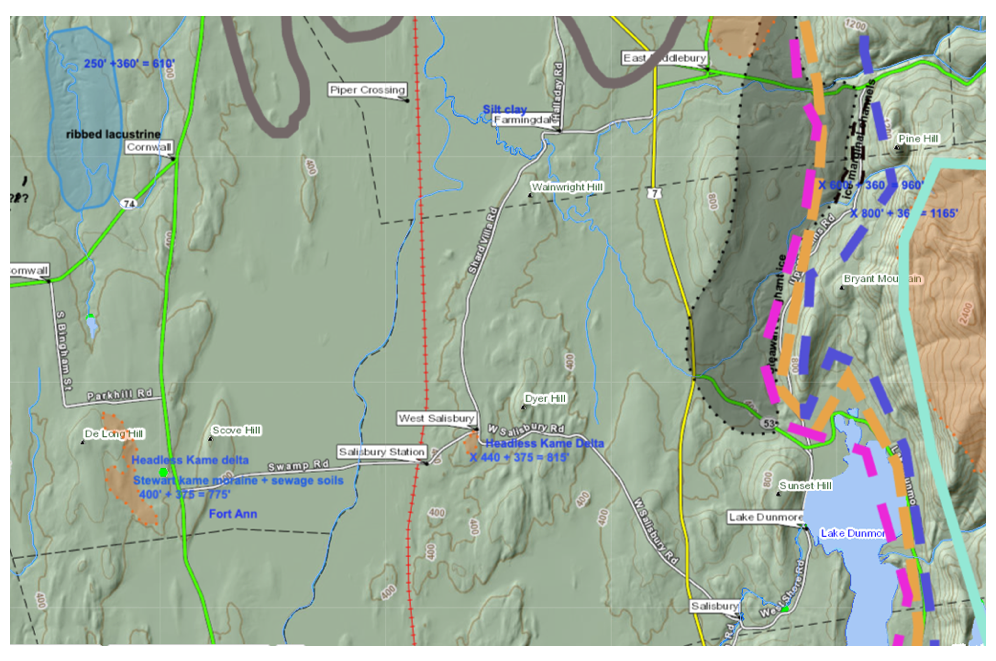
The deposit along DeLong Hill is identified on the State surficial map as “kame moraine” Similarly to the east, at West Salisbury, is a deposit identified on the State map as “Lake Sand.” Both the Delong Hill and West Salisbury deposits are at the Fort Ann level, and are here interpreted as “Headless Kame Deltas,” signifying that their formation does not correspond with any present-day drainage, but likely were related to and associated with the Otter Creek ice stream at the grounding line of the calving ice margin. These deposits likewise are indicated on the soil sewage favorability tab on VCGI as more granular soils. LiDAR imagery does not show kamic topography but instead suggests low, relatively subtle topographic rises. These rises are marked by mining excavations, confirming the granular nature of the soils. In addition, LiDAR imagery shows curvilinear features which do not appear to be associated with human activity such as agricultural drainage controls. These approximately follow the topography and may be grounding line marks.
3. Although not mapped as such, Salisbury Swamp between these two Headless Deltas may be floored by thickened lacustrine deposits.
4. Also shown on the above map is the aforementioned boundary, marked as “boulder/non-bouldery” on the above map.
5. As discussed above the Ice Margin Lines northwest of Snake Mountain may represent calving ice margin features.
6. It is significant to note that whereas the Delong Hill and West Salisbury calving margin features are at the Fort Ann level, to the northwest, are features(as discussed below in the section on Ice Marginal Lines) ) on the Basin floor northwest of Vergennes which likely represent a calving ice margin with the grounding line at the Champlain Sea marine limit. These “Ice marginal Lines” immediately northwest of Snake Mountain(#13), the origin of which as mentioned above is not yet definitively established, may be calving margin features, possibly Calving Wedge deposits or Mega-Scale Lineations (as discussed below),and are likewise suggestive of and consistent with calving of this ice stream in T8 and Champlain Sea time. This supports the interpretation that, like the history in the LaPlatte Basin, calving in the Middlebury Bench in Fort Ann time, was followed by another calving event.
7. Also, in the Middlebury(M) area at Chipman Hill(#14) is a stagnant ice deposit with stratigraphic variations identified by Calkin, and a possible landslide scar induced by the same margin, which may likewise relate to the calving margin of this ice stream. On the east flank of Chipman Hill, on the eastern margin of Middlebury Village, is unusual scalloping of the terrain, possibly slump features, close to the Fort Ann level, as shown on the VCGI screen shot below:
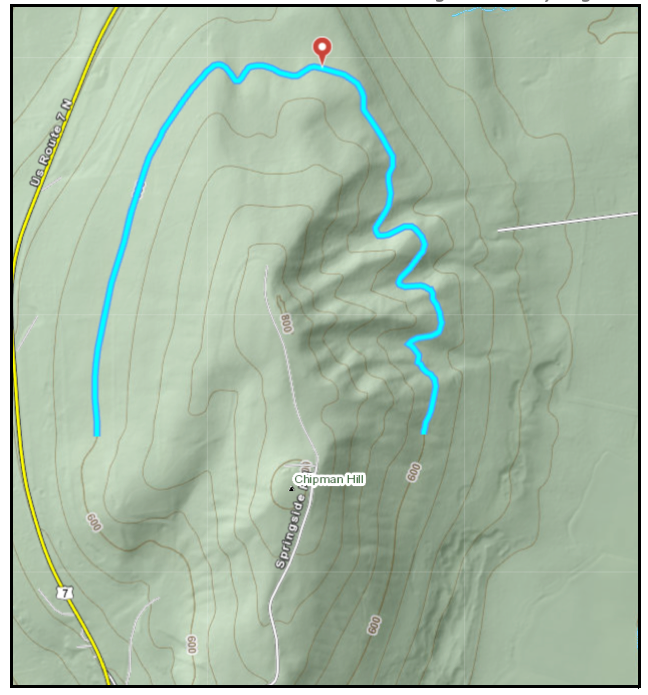
The contour for the 600 foot(183 m)(local) elevation, which is close to the Fort Ann level, is partially highlighted. The explanation for the scalloping is uncertain but may represent subaqueous land terrain instability failures caused by erosion at the Fort Ann level, as described in the glaciology literature for present day grounding lines. Interestingly, if the scalloping was indeed caused by slumping, then it is notable that no corresponding debris pile at the base of the hillside is evident, which may be attributable to the presence of ice at the time of slope failure. Also at the base of the eastern slope of Chipman Hill, just below the 600 foot(183 m) contour are stagnant ice deposits, as reported by Calkin, with “till sandwich deposits.”
- As can be seen on the above map B, the southward projection of the bouldery soils is close to and essentially marks the Champlain Sea at the marine limit, including for both the Otter Creek and Trough ice streams.
- In the Bridport area are features(#15) identified by Connally, as discussed above, which he interpreted as indictive of a readvance, but are here believed to represent the calving margin of the Trough Ice Stream. The evidence cited by Connally for the” Bridport Readvance” is consistent with oscillations of a calving margin, at an elevation on the Basin floor at approximately the Champlain Sea near its southern limit, and while not requiring do not preclude a readvance. As suggested previously, Connally’s Bridport readvance is correlated with Wright’s readvance evidence along the LaPlatte River, and with the readvance evidence identified in the Missisquoi Basin by Cannon and Wagner, marking a calving margin along the margins of a long convex lobe in the Champlain Basin in T8 and Champlain Sea time.
6) Winooski Ice Sub-Lobe or Ice Stream
The map shown below is an enlargement of a portion of Map B, in the vicinity of the mouth of the Winooski.
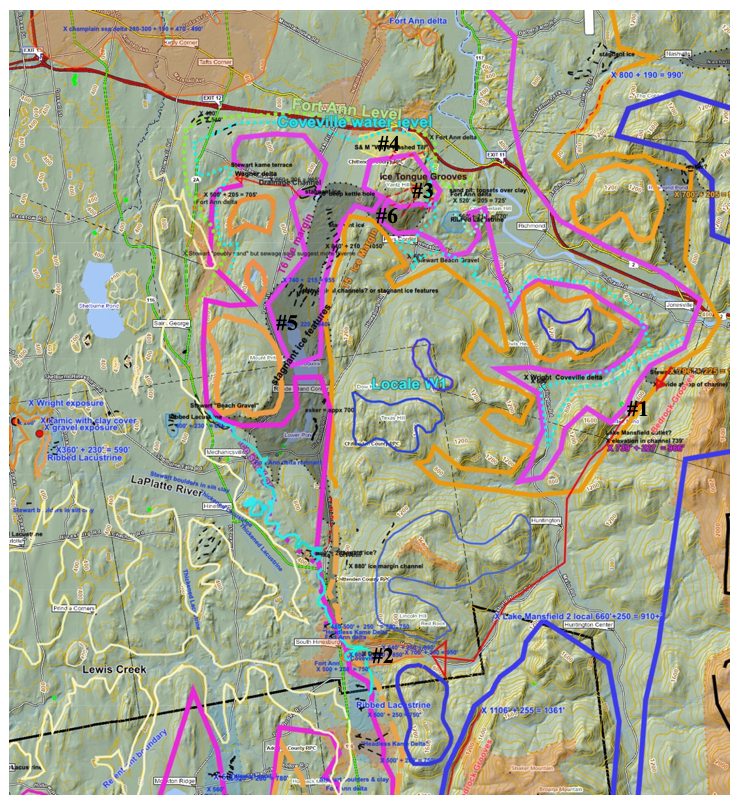
As indicated above, the evidence supports the presence of a Winooski sub-lobe, that extended into the Winooski Basin as a destabilized ice stream. However, the lacustrine sediment associated with Coveville Lake Vermont in this Basin is not mapped as bouldery on the State map, presumably because water depths of Lakes Winooski and Mansfield were insufficient for calving. However, Fort Ann lacustrine deposits on the State map at the mouth of the Winooski Basin are mapped as bouldery, which again supports the development of a calving ice margin in Fort Ann time, associated with the drainage of Lake Mansfield and opening of the basin. 41Whether or not the terms “ice stream” or “ice tongue” are appropriate is largely a semantic matter. Numerous features associated with the calving ice margin are identified in the area. Appendix 4 discusses these features in the context of a larger discussion.
Obviously, this map contains a very substantial amount of information, and again much of this is discussed in Appendix 4. The following is a summary related to the development of a calving ice margin. associated with the lowering of the Winooski Basin to Coveville and then Fort Ann waters, beginning in late T6 time. The LaPlatte basin is shown on the lower portion of the map, with many of the calving ice margin features as just described in the preceding.
The T4-T5-T6 step down ice margins are marked by blue, orange, and maroon lines. The pale yellow lines trace the 400 foot(122 m) contour, to give a better sense of physiography in the area. This gives a sense of the LaPlatte Basin, and also the small basin described above in conjunction with the features associated with Oak Hill and Sucker Brook. The bright neon blue line marks the 520 foot(158 m) contour, which is just above the Fort Ann level. The Fort Ann delta at South Hinesburg is at a local elevation of about 500 feet (152 m), which likewise corresponds with the elevation of the above described calving ice margin features in the area.
The maroon colored T6 ice margin, likely as is the case with all ice margins, was a hybrid type, and is partly marked by a) active ice margin features as at the Bedrock Groove at Lake Gillett(#1) which according to Wright et al represented the outlet for Lake Mansfield 1, related to the Coveville delta at South Hinesburg(#2), b) the Ice Tongue Grooves at Yantz Hill(#3), c) Wave Washed Till at Yantz Hill(#4) which is here interpreted as associated with drainage of Lake Mansfield 2, and d) a major stagnant ice margin(#5) south of Williston. This stagnant ice deposit includes LiDAR markings and an esker which are graded southward to the Fort Ann level in the LaPlatte Basin. The northern portion of this deposit marks an ice margin at #6 related to drainage in a channel at Oak Hill leading to deposits along Sucker Brook(as mapped by Springston and DeSimone), here interpreted as deltaic features at the Coveville and Fort Ann levels, in close proximity to the ice margin. The bright blue and green dotted lines at the mouth of the Winooski mark the Coveville and Fort Ann strandlines, which are marked by LiDAR imagery features. Together, again as discussed in Appendix 4, these features relate to the progressive recession of the ice margin including the development of a calving ice margin associated with Fort Ann time, and the opening of the Winooski Basin. Not shown are T7 ice margin features just to the north in the Essex and Colchester areas, with esker drainage to a Fort Ann delta, as part of the continuing northward recession of both a standing water corridor and calving ice margin in T7 time, which is believed to have continued northward into Quebec, with a subsequent readvance marked as the T8 margin in the Missisquoi Basin extending southward as a long convex lobe associated with the third phase of calving.
7) Summary for Calving ice margin in Middlebury Bench area
To summarize, it is believed that the Champlain lobe was a long, convex lobe with a T3 or T4 to T6 step-down recession of both its southern and eastern margins associated with local water bodies giving way to a narrow open water corridor of standing water at the Coveville level in early T6 time. Calving likely began in the “Deep Lake” portion of the Basin in early T6 and Coveville time. This was followed by a second calving event in late T6 time associated with the Coveville to Fort Ann transition and continuing through T7 time. This event was also associated with the drainage of Lake Mansfield and the breakout of Lake Iroquois at Covey Hill. A third calving event occurred in T8 time associated with the lowering from Fort Ann to Champlain Sea levels. Whereas ice margin recession likely was oscillatory in nature, T8 time was associated with a more substantial oscillation or readvance of the ice margin, as marked by evidence in the Missisquoi Basin, the LaPLatte Basin, and near Bridport.
However, as noted above,Dave Franzi’s questioning of the ability of the ice sheet to sustain such a long convex lobe raises the possibility that much of this convex lobe may have been predominantly a remnant stagnant ice mass, with the T8 readvance of active ice limited to the Missisquoi Basin, and the “readvance “ evidence presented by Wright in the Charlotte area and Connally in the Bridport area being some sort of spurts associated with the collapse of the Champlain lobe.
8) Evidence for Calving in the Champlain Basin “Trough” and Deep Lake areas
A fifth ice stream is marked on the VCGI map in the low area west of the Bench area and immediately west of Snake Mountain. The evidence in support of this calving margin is first the presence of the associated physiographic trough, and second the southward projection of the bouldery silt-clay bottom-set deposits on the floor of the Basin. The initial, early interpretation given here has been that the greater depth of Lake Vermont in this western trough favored an earlier phase of calving in this western trough, prior to the calving in the Middlebury Bench area. However, this interpretation is complicated by the presence of “Ice Margin Lines” near Snake Mountain on the Basin floor as discussed below, which raise the possibility that the trough may have been occupied by an ice stream with a convex calving ice margin extending far to the south in Champlain Sea time. This possibility represents a very different, alternative hypothesis, as discussed above in the introduction of this section on calving ice margins. Several means of making this distinction are possible:
- Whereas if the Champlain lobe projected southward, silt-clay soils on the Basin floor within the marine footprint should only be marine and not freshwater, and further, marine bottom-set soils should not be varved. However, not all freshwater bottom-set deposits are varved. Thus, identification of bottom set deposits as being marine or freshwater is not readily determinable.
- If the Champlain lobe projected southward and receded along calving ice margin, deltaic deposits formed along the calving ice margin should show geomorphic or subsurface evidence of the close proximity of the calving ice margin at the Champlain Sea marine limit. However, obviously, the Champlain Sea’s presence likely was long enough such that this evidence might have been buried or eroded in later Champlain Sea time. For example, the Winooski and Lamoille Champlain Sea deltas are substantial deposits. Neither of these deltas as mapped by Wagner in the 1970s or in this present VCGI study show evidence of stagnant ice presence. But again, the absence of such evidence may have been eroded or buried by subsequent actions at the marine limit postdating the presence of a calving margin if present.
9) Evidence for Calving in the Lamoille and Black Creek Basins
As previously noted, the State surficial geology map shows bouldery silt-clay deposits extending northward on the Champlain Basin floor,northward to the Quebec boundary. Thus, as suggested by Stewart and MacClintock, once begun, calving of the ice margin continued for the remaining time of ice presence in Vermont.
In Wagner’s mapping in the 1970s, a deposit was identified on the divide between the Lamoille and Black Creek Basins, consisting of kamic topography, but with fine grained lacustrine sediment cover. At that time this deposit was not understood, but in the context of this present study this deposit corresponds with a Ribbed Lacustrine deposit. The elevation of the deposit is at the T6 or T7, and Fort Ann Lake Vermont levels. Black Creek Basin is long and narrow basin, extending southeasterly from the vicinity of Sheldon Junction in the Missisquoi Basin. VCGI mapping suggests that a long narrow T6-T7 lobe of the ice sheet extended up the Black Creek Basin to the Ribbed Lacustrine deposit, where a calving margin may have existed in Fort Ann time, as part of the continued northward recession of the calving ice margin with the interpretation given above for such deposits. This interpretation suggests that the following T8 lobe, which again extendd southward in the trough to the Bridport area, was quite narrow.
In addition, further to the northwest, down the Black Creek Basin are features mapped on VCGI as Headless Deltas. The Fort Ann deltaic deposit at Bakersfield, which is within the Black Creek Basin has definitive LiDAR markings indicating that this is a kame delta, at the T7 level, signaling the close association with the ice lobe in the Black Creek Basin. Likewise, deltaic deposits at the Fort Ann and T7 level on the floor of the Lamoille Basin west of the Lamoille Ice Tongue Grooves show LiDAR evidence of having formed along the margin of the Lamoille lobe, as kame deltas.
In essence, this evidence suggests that an ice lobe in the Missisquoi Basin extended up the Black Creek Basin to its divide with the Lamoille Basin which was likewise occupied by an ice lobe, with the Ribbed Lacustrine deposit having formed at the juncture of the two lobes. And further, that subsequent recession of the Black Creek lobe was by a calving ice margin, fed by an ice stream in the Black Basin. The floor of the Black Creek Basin is marked on the State map by a unit identified as “silt, silty clay, and clay,” with no indication that these soils are bouldery as would be expected. The floor of much of the Black Creek Basin is below the marine limit which may have served to blanket bouldery deposits, if present. Nor has any evidence for thickened lacustrine deposits similar to the Middlebury Bench calving ice margin been found. Nevertheless, it is here suggested that a calving ice margin likely occupied the Black Creek Basin, associated with an ice stream in that basin which was favored by its orientation relative to the Champlain lobe. Whereas Fort Ann waters likely were relatively shallow, the thickness of the Black Creek ice lobe apparently was thin enough to favor flotation of the ice margin during its recession.
The progressive recession of the calving ice lobe in the Black Creek Basin likely was similar to the recession of the calving ice margin in the LaPlatte Basin. Based on the reported identification of Fort Ann (termed Lake Candona) strandline features in Quebec it is suggested that the ice margin in Fort Ann time receded north of the Quebec border. The Champlain Sea level is marked by deposits in the Missisquoi Basin mapped as being associated with the T8 ice margin. However, it is likely that the T8 margin in this basin is related to the readvance, as discussed previously, and therefore may be significantly younger than the receding calving margin in the Black Basin. This issue requires further study.
10) Regional Perspective on Calving Ice Margin History
The preceding examines calving ice margin features at a closeup, detailed scale including substantial discussion of local deglacial history. The following examines these features at a larger, regional scale perspective. Section 3 of this report presents this same historical view but in a broader perspective, including suggested possible correlations between Vermont and New York ice margins.
The maps below depict the ice sheet, including calving margins associated with proglacial water bodies at selected times, helping to flesh out the calving story. Owing to the small scale, these maps are schematic and intended only to give a general, visual, pictorial sense of the spatial and historical relationships. The positions of the ice margins and footprints of proglacial lakes are only approximate. VCGI maps give a more accurate representation of these boundaries.
As discussed above, whereas our conventional paradigm-ic thinking leads us to think of the ice sheet recession as taking place progressively northward, for which evidence as discussed above exists, this recession likely took place in a narrow standing water corridor along the ice margin, with a westerly widening component, for which there as well evidence is identified in the preceding.
- Early T6 and Coveville Lake Vermont Time
The map below depicts the ice sheet at early T6 time and associated Coveville Lake Vermont, prior to the initial phase of calving in the Middlebury Bench. Coveville Lake Vermont occupied a long narrow corridor along the eastern foothills in Vermont, prior to the opening of the Winooski Basin and draining of Lake Mansfield. It is possible that a similar corridor, as depicted, existed along the western margin in New York, perhaps with calving associated with the “Deep Lake” portion of the Basin, as discussed above, but this is undocumented and is beyond the scope of VCGI investigation here.
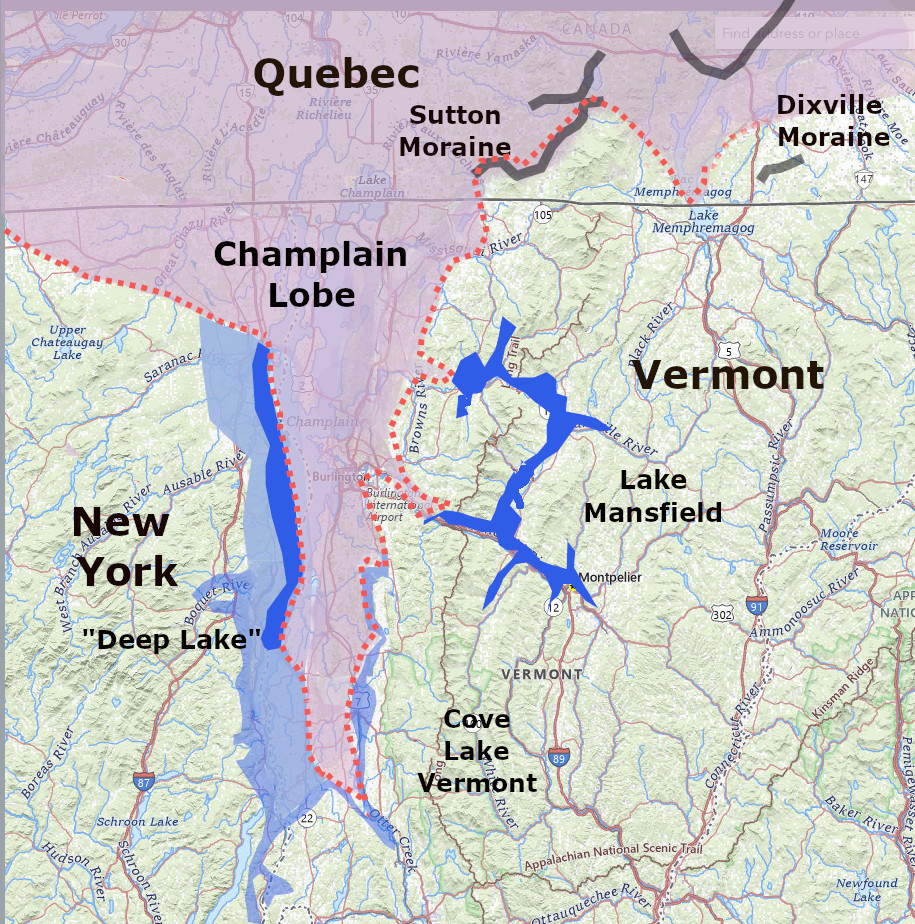
To set the stage for T6 time and the early calving story, the following summarizes pertinent elements of the deglacial history leading up to early T6 time, when calving began in the Champlain Basin:
- The earliest time marking the recession of the Champlain lobe, like all T times, levels, and margins, is marked by ice margin features of a hybrid margin, with both active and stagnant ice components, beginning in T3 time.
- This recession proceeded from the beginning of the Lobate Phase in T3 time, when Champlain lobe sub-lobes in the Vermont Valley extended northward from the Bennington vicinity, and in the main Basin extended northward from New York, as mapped by DeSimone and LaFleur’s position #1 (as discussed elsewhere herein). For example, in the Vermont Valley, the margin of the T3 lobe is marked by numerous, semi-continuous stagnant ice deposits and Ice Marginal Channels, extending northward from the Bennington area in the Vermont Valley along the foothills and floor of the Vermont Valley, continuing northward along the foothills to the Lincoln vicinity, north of which the T3 margin was in the Nunatak Phase, as marked by Ice Marginal Channels.
- Both stagnant ice margin deposits and Ice Marginal Channels mark the progressive T3 to T6 recession of a hybrid type margin in a step-down sequence, showing the close association of the receding ice margin with the development and coalescence of progressively lower, local proglacial lakes, in both the Vermont Valley and the main basin floor, wrapping around the nose of the Adirondacks, and extending into New York.
- According to Franzi (2025, personal communication) a similar step-down sequence is likewise marked by an almost continuous step-down succession along the eastern and northeastern flanks of the Adirondacks. It is here presumed that this succession corresponds with the same Vermont pattern.
- In the Vermont Valley, the T3-T6 recession of the sub-lobe is marked by almost continuous succession of stagnant ice deposits on the floor of the Valley. Again, this star-step recession is likened to “multiple rings in a slowly draining bath tub,” which in essence is the “Bath Tub Model.”
- As part of the recessional history leading up to T6 time, are: a) the successive “Disconnections” and en masse stagnations of ice in three portions of the Connecticut Basin, in T3- T4 time; b) the linkage of the T4 margin with the White Mountain Moraine System, as a readvance; c) the major stagnant ice T3 and T4 deposits at Bennington and Rutland, respectively, identified as moraines by Stewart and MacClintock, including evidence consistent with a T3/T4 readvance at these locations; d) the progressive development of Lake Winooski iin T4 time in the Lamoille and Winooski Basins as mapped by Wright et al, with VCGI evidence indicating the development of a “Disaggregated” hybrid margin on the eastern perimeter of Lake Winooski and Disconnection of ice masses in deep basins on the western margin of Lake Winooski; e) the recession of the T4 -T6 ice margins in the upland interior allowing for the expansion of Lake Winooski, followed by its lowering to Lake Mansfield; f) the parallel recession of the T3 -T6 margins in the Memphremagog Basin, leading to a small remnant lobe tip in the Memphremagog Basin in T6 time associated with proglacial Lake Memphremagog; g) Drainage Line evidence associated with drainage along ice margins in T4 -T6 time, providing links between the Memphremagog Basin to the Lamoille and Winooski Basins, to the main Champlain Basin, as part of the progressive step-down ice margin and proglacial lake history; h) the development of Ice Tongue Grooves at the mouths of the Otter Creek, Winooski, and Lamoille Basins in T4-T6 time, and the formation of the Shattuck Mountain Potholes.
- In early T6 time the VCGI evidence indicates that the progressive lowering and coalescence of proglacial lakes in the step-down recession led to Coveville Lake Vermont, as marked for example by kame delta deposits at Benson Landing, Castleton, Rutland and Proctor, Brandon, and East Middlebury. The evidence indicates the ice margin was in close proximity to the strandline, which suggests the Coveville waters occupied a narrow corridor, as suggested. Not shown on the above map but described at length elsewhere are the development the T4-T6 stepdown sequence including an ice margin position at the head of the LaPlatte Basin associated with the Coveville delta, and as well the ice margin position associated with the Coveville South Hinesburg delta.
- In later T6 time and T7, further recession led to the opening of the Winooski Basin, the draining of Lake Mansfield, and the development of a substantially documented progression of a second and third phases of calving in T7 and T8 time.
- Owing to the scale of the above map, the T6 ice margin as depicted here is highly schematic and imprecise. The T6 margin in the Missisquoi Basin is well defined by VCGI mapping, notably marked by a prominent stagnant ice deposit in the Berkshire vicinity, as described elsewhere herein. The elevation of this deposit correlates with the elevation of the Sutton moraine, suggesting a correlation as shown on the above map. This correlation is also supported by a detailed examination of multiple sub-lobes in the Missisquoi Basin, in accordance with physiography, as discussed with Locales.
The preceding summary thus sets the stage for discussion of the development of Coveville Lake Vermont in early T6 time. VCGI mapping indicates that Coveville Lake Vermont extended along the eastern margin of the Basin, northward from the mouth of the Vermont Valley, along the foothills, in close association with the ice margin, again indicative of a narrow, more or less open-water, “Disaggregated” ice margin corridor. No evidence of calving is associated with this corridor. However, calving is inferred to have begun in the area of the main basin floor, specifically associated with the substantially lower elevations of the Basin floor related to the “Deep Lake.” The basis for this is solely the substantial water depths of Lake Coveville in that area. This was the first of three progressive phases of calving, again as described elsewhere. Likewise, also as described elsewhere, Manley and Manley 42https://www.chesapeaketech.com/wp-content/uploads/2016/01/LakeChamplain_study2.pdf?utm_source=chatgpt.com have recently published a detailed bathymetric map of the basin, showing the extent of this trough. The Deep Lake footprint shown on the above map is schematic and not intended to be an accurate delineation.
Again, no specific evidence has been found and mapped on VCGI in support of this early, first phase of calving in early T6 time. The margin of Coveville Lake Vermont on the above map, including in both Vermont and New York, is drawn to correspond with the Coveville strandline, basically as delineated by Chapman, and Wright, et al., but again is schematic and imprecise. The footprint of the open water fronting the calving is Coveville Lake Vermont, but its associated calving margin or grounding line are likewise not marked by VCGI mapping and are intentionally schematic, solely to infer the concept of the calving. It is assumed that this calving was associated with a Trough ice stream of the Champlain lobe, but no specific evidence for this ice stream has been found.
Lengthy conversations with David Franzi (2025) indicates that he concurs that calving likely occurred in conjunction with the deeper waters of the Basin. It is here believed that specific evidence for this calving may occur in New York. On the Vermont side, any evidence for this phase of calving likely was subsequently buried beneath bottom sediments or eroded by Lake Vermont. The physiography of the basin floor on the Vermont side is low and relatively flat, below the Coveville level. Thus, no evidence for calving at this time was expected and none was found by the VCGI mapping. The work by Manley and Manley at Middlebury College on the bathymetry and sediment stratigraphy of Lake Champlain is especially intriguing. It is possible that this may lead to documentation for (or against) the interpretation given here for calving.
2) Late T6 and Early Fort Ann Time – beginning of calving in Middlebury Bench
The following map shows the Champlain lobe in late T6 time when Coveville lowered to the Fort Ann level, initiating calving in the Middlebury Bench. The position of the ice margin stood just below the heads of the LaPlatte and Little Otter Creek-New Haven River re-entrant Basins, and in the Otter Creek Basin at Delong Hill and West Salisbury. Again, the location and nature of the margin in New York are uncertain, but as discussed above and more carefully illustrated in Section III, this time is believed to correspond with the Lake Iroquois breakout at Covey Hill.
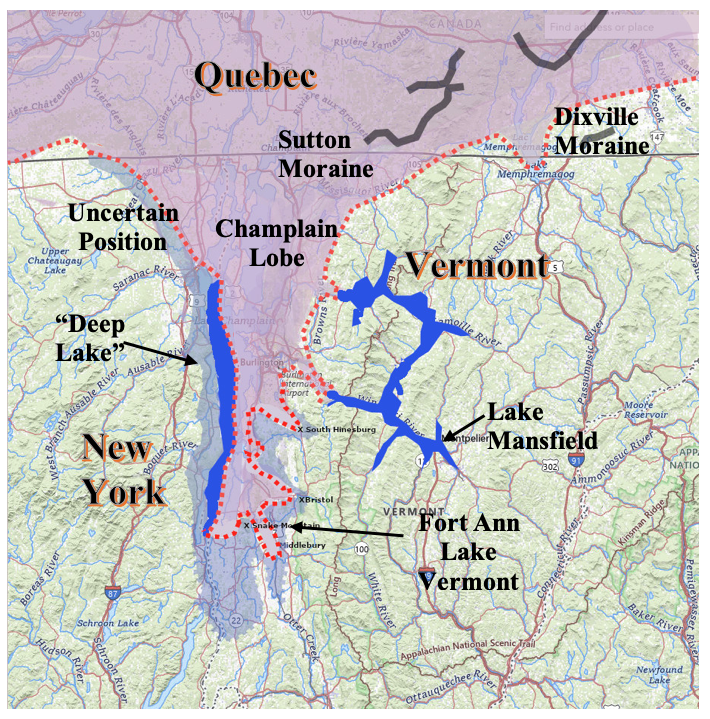
As before, owing to the map scale, this map is imprecise and intended to be schematic. The position of the ice margin stood just below the heads of the LaPlatte, and Little Otter Creek-New Haven River re-entrant Basins, and in the Otter Creek re-entrant Basin at Delong Hill and West Salisbury. The footprint of Fort Ann Lake Vermont is taken from Chapman and Wright et al.
Again, the above map is intentionally schematic, but in any case suggests that the Champlain lobe in T7 time was long and convex in shape. The basis for this is discussed elsewhere but includes calving ice margin features in the LaPlatte River, perhaps Lewis Creek, Little Otter Creek, New Haven River, and Otter Creek Basins. Further, this interpretation is as well part of a recessional history which is substantial and robust with many pieces of evidence that together tell a compelling story about calving, the configuration of the Champlain lobe, and its recession. For example, at Essex, Vermont, two eskers are mapped with drainage graded to the Winooski Fort Ann delta. A Fort Ann delta deposit along Sucker Brook corresponds with deposits mapped by DeSimone in the Williston area as ice proximal. Whereas in the original mapping the T7 margin was extended westward from the Essex area, the evidence forced a more convex lobe extending further south at this time. And again, many ice margin features further south document the configuration of a long convex lobe and calving margin at this time. Whereas this map is for early T7 and Fort Ann time, it is believed that in later Fort Ann time the eastern ice margin substantially receded by the northward extension of the long, narrow “Disaggregated ice margin and associated Fort Ann corridor into Quebec, leading to the opening of the ice to allow Fort Ann drainage to the Champlain Sea in T8 time.
Dave Franzi and I exchanged views about this map. Franzi takes issue with the suggestion that the Champlain lobe extended far to the south as a long convex lobe at this time. He believes that the ice margins depicted by Chapman for the Champlain Basin and by Parent and Occhietti in Quebec, both of which show the ice margin in Fort Ann time flattened and located far to the north, are essentially correct. As I indicated to Dave, my early mapping on VCGI showed the T7 margin extending westward across the basin from the Essex eskers, and likewise the T8 margin westward from Greens Corners, essentially as a flattened calving margin. However, as my mapping continued I was forced to regard the margin as more lobate.
In my opinion the Chapman and Parent and Occhietti depictions of the ice margin are based on a paradigmic model preconception, but not actual documentation of the ice margin at these northerly positions. Part of Dave’s argument is based on surface ice gradient estimates which he contends indicate it was very difficult for the Laurentide ice sheet to sustain such a long convex lobe. I concur, but believe that this ice lobe was remnant ice remaining during ice margin recession. Further, I believe that the Fort Ann Corridor that extended northward on the New York side of the basin, related to the Deep Lake, served to open the New York portion of the basin much more substantially, in effect like a fault line resulting in very different deglacial histories on the New York versus Vermont sides. Further, I believe that in fact the lobate ice margin as now drawn here was unstainable, which helps to explain the evidence indicating the rapid recession of the ice margin, essentially the collapse of the Champlain lobe.
3) T8 and Champlain Sea Time
As discussed above and shown on the map below, the T8 margin, at the transition between Fort Ann and Champlain Sea, time was a long narrow convex lobe, extending as far south as the Bridport area corresponding with features mapped by Connally which are consistent with a calving ice margin.
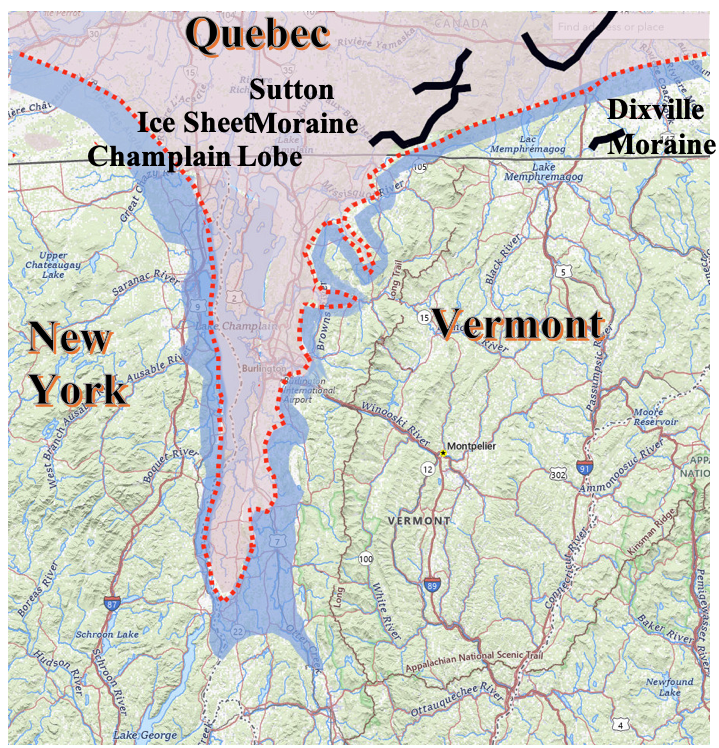
The long narrow standing water Fort Ann corridor, which had extended northward into Quebec in T7 time, by this explanation, opened the corridor leading to the invasion of the Champlain Sea. The T8 margin as shown here represents a readvace, as best documented in the Missisquoi Basin, after the opening of the Basin for the Champlain Sea. Again, the depiction here is schematic only.
The evidence presented previously indicates that during T7 time the ice margin for ice streams in the Middlebury Bench receded in the second phase of calving, with the third phase triggered at T8 time by the lowering of water levels from Fort Ann to Champlain Sea. And again, Franzi takes issue with the configuration of a long convex lobe, for which my rebuttle includes substantial evidence for the Vermont history, east of the Deep Lake “fault line, ” as presented in the preceding.
Footnotes: